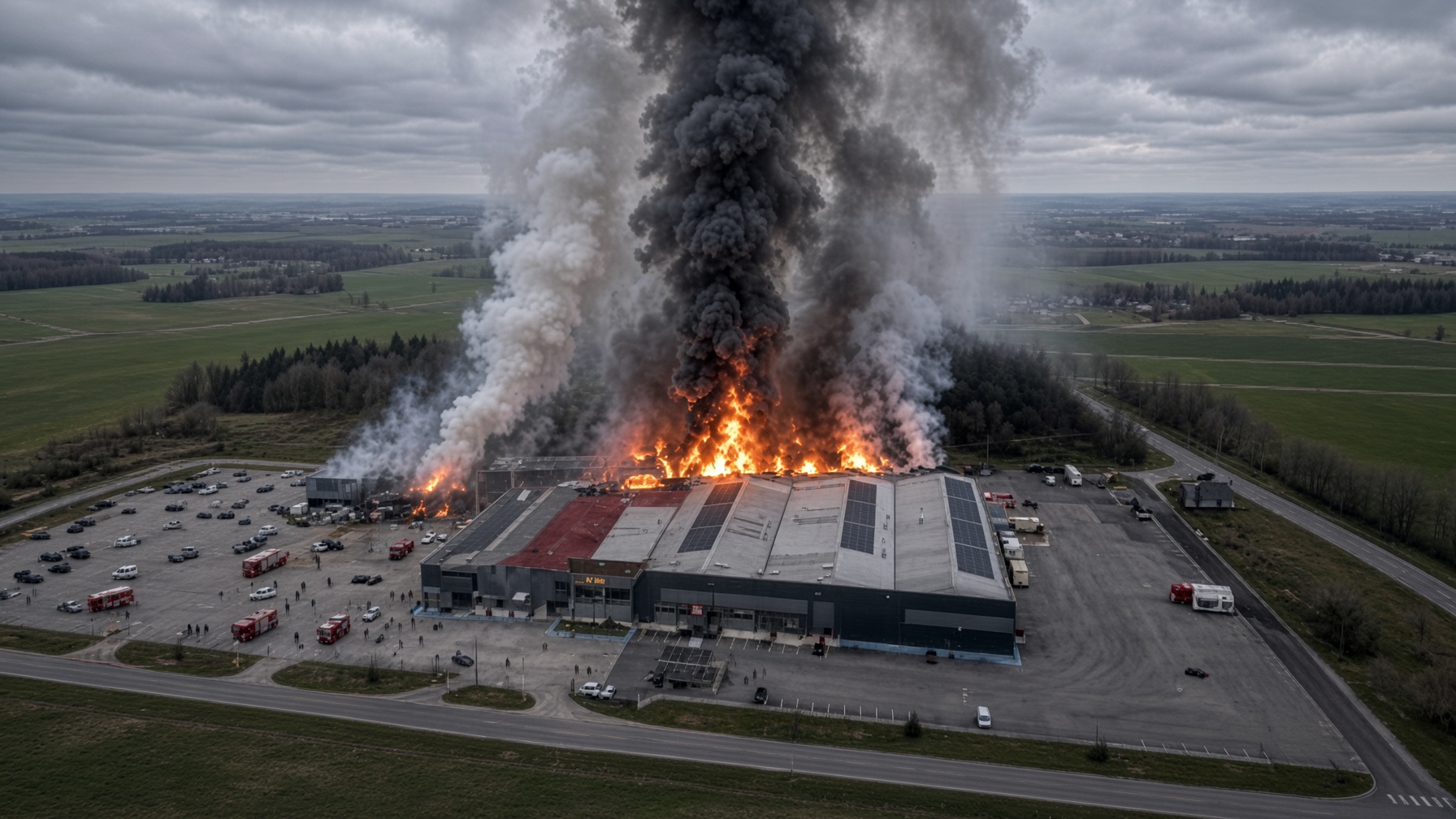
TRIKALA, Greece — A catastrophic pre-dawn fire swept through a major commercial bakery production facility in central Greece, claiming the lives of four factory workers, hospitalizing several others, and triggering a comprehensive inter-agency investigation into industrial fire-safety compliance.
The disaster erupted at approximately 4:00 a.m. local time inside a sprawling manufacturing complex operated by prominent Greek biscuit maker Violanta, situated just outside the city of Trikala, roughly 200 miles north of Athens. Thirteen employees were stationed across the plant floor staffing an overnight processing, baking, and packaging rotation when heavy flames rapidly consumed core sections of the primary structural hall.
While eight employees successfully evacuated through perimeter emergency exits as early alarms echoed through the compound, four workers became trapped by rapidly spreading flame fronts and thick, suffocating smoke. Search-and-rescue teams operating inside the charred wreckage recovered their remains hours later once interior containment operations stabilized the building’s compromised superstructure.
A prolonged search operation was initiated during the early hours to account for a fifth worker initially feared missing amid conflicting shift manifests, before personnel logs were definitively reconciled. Seven people—six plant employees and one responding firefighter—were transported by national ambulance services to regional hospitals across the Thessaly region for emergency triage, treatment of acute smoke inhalation, and burn care.
Emergency Operations and Structural Perils
The Hellenic Fire Service initiated a massive emergency mobilization across the regional command, dispatching approximately 40 firefighters supported by 15 heavy fire engines, water tankers, and specialized high-reach aerial platforms. First-arriving units encountered an advanced, high-heat inferno with dense, toxic plumes of black smoke pouring from punctured roofing panels and secondary ventilation exhaust points.
Crews confronted intense thermal conditions as the fire threatened to spread into adjacent processing wings, dry ingredient depots, and bulk commercial baking lines. Fire command established defensive perimeters while deploying specialized interior search teams equipped with breathing apparatus to suppress flames along primary arterial corridors. Responders prioritized shielding heavy industrial refrigeration machinery, pressurized coolant lines, and agricultural raw-ingredient silos from catastrophic thermal exposure.
Fire commanders confirmed that while the primary fire was brought under containment after several hours of coordinated suppression, tactical overhaul operations stretched through the remainder of the day. Crews systematically doused deep-seated interior flare-ups beneath fallen metal roofing panels and mitigated structural collapse risks before forensic specialists could be cleared to access the structural core.
Arson and Industrial Safety Teams Deploy
Specialized forensic analysts from the Hellenic Fire Service’s Arson Crimes Directorate (DAEE) and the regional Labor Inspectorate deployed to the incident site to establish the precise ignition source and chronological sequence of failure.
Preliminary depositions collected from surviving third-shift personnel described a sharp, concussive acoustic event immediately preceding a sudden burst of intense fire along the production line. Investigators emphasized that forensic analysis has not yet established whether a mechanical failure or pressurized gas breach triggered an initial explosion, or whether secondary concussions occurred when escalating ambient heat compromised pressurized equipment, pneumatic lines, or commercial baking tunnels.
State investigators have mapped out a detailed technical agenda, focusing their initial forensic assessment on the plant’s high-voltage electrical arrays, industrial gas-fired ovens, exhaust extraction conduits, and automated thermal cut-offs. Authorities formally impounded the facility’s historical maintenance logs, regulatory compliance certifications, equipment inspection paperwork, and closed-circuit digital recording systems that logged activity up to the moment system power failed.
Public safety officials cautioned against ungrounded speculation circulating across regional digital networks, stating that formal technical determinations will depend entirely on laboratory metallurgical testing, debris-pattern analysis, and physical analysis of the plant’s automated supervisory control and data acquisition (SCADA) telemetry.
Corporate Response and Community Fallout
In a formal statement issued following the tragedy, executive leadership at Violanta confirmed the loss of life, expressed profound devastation, and pledged unrestricted transparency and collaboration with civil prosecutors, fire marshals, and workplace regulatory agencies.
The company stated that executive staff and regional human resources teams had established direct liaisons with the families of the victims to coordinate emergency financial support, arrange hospital transport logistics, and deploy trauma-counseling specialists for surviving workers and first-line shift supervisors who experienced the disaster firsthand.
The fatal blaze has sent shockwaves through Trikala, Karditsa, and surrounding communities in the Thessaly industrial belt, where Violanta operates as one of the regional economy’s primary employers, supporting hundreds of direct manufacturing jobs and extensive agricultural supply chains. Municipal leaders, regional governors, and parliamentary representatives visited the exterior perimeter throughout the afternoon to convey formal condolences, promising municipal social welfare assistance and structural support programs for the affected families.
Scrutiny on Industrial Standards and Evacuation Corridors
The fatal outcome has reopened national scrutiny surrounding industrial manufacturing safeguards, occupational protections, and emergency egress protocols across southern Europe’s food processing sector.
Plants of this scale operate continuous-heat thermal baking infrastructure, heavy automated conveying equipment, and environments subject to fine flour and organic dust accumulation. Under European Union industrial directives and Greek occupational health codes, these environments mandate specialized explosion-mitigation zoning, automatic thermal deluge systems, pressurized emergency stairwells, and luminous fail-safe evacuation routing.
Regional labor prosecutors and technical safety auditors are examining whether the facility’s automatic water and foam suppression systems operated as designed, whether audible alarms triggered immediately across the entire plant footprint, and whether emergency egress corridors were entirely free of obstructions.
While the survival of eight shift workers demonstrates that perimeter evacuation routes functioned effectively in several sectors of the plant, investigators are focusing their inquiry on why the four victims were unable to reach exterior exits before environmental conditions inside their working zone turned fatal.



