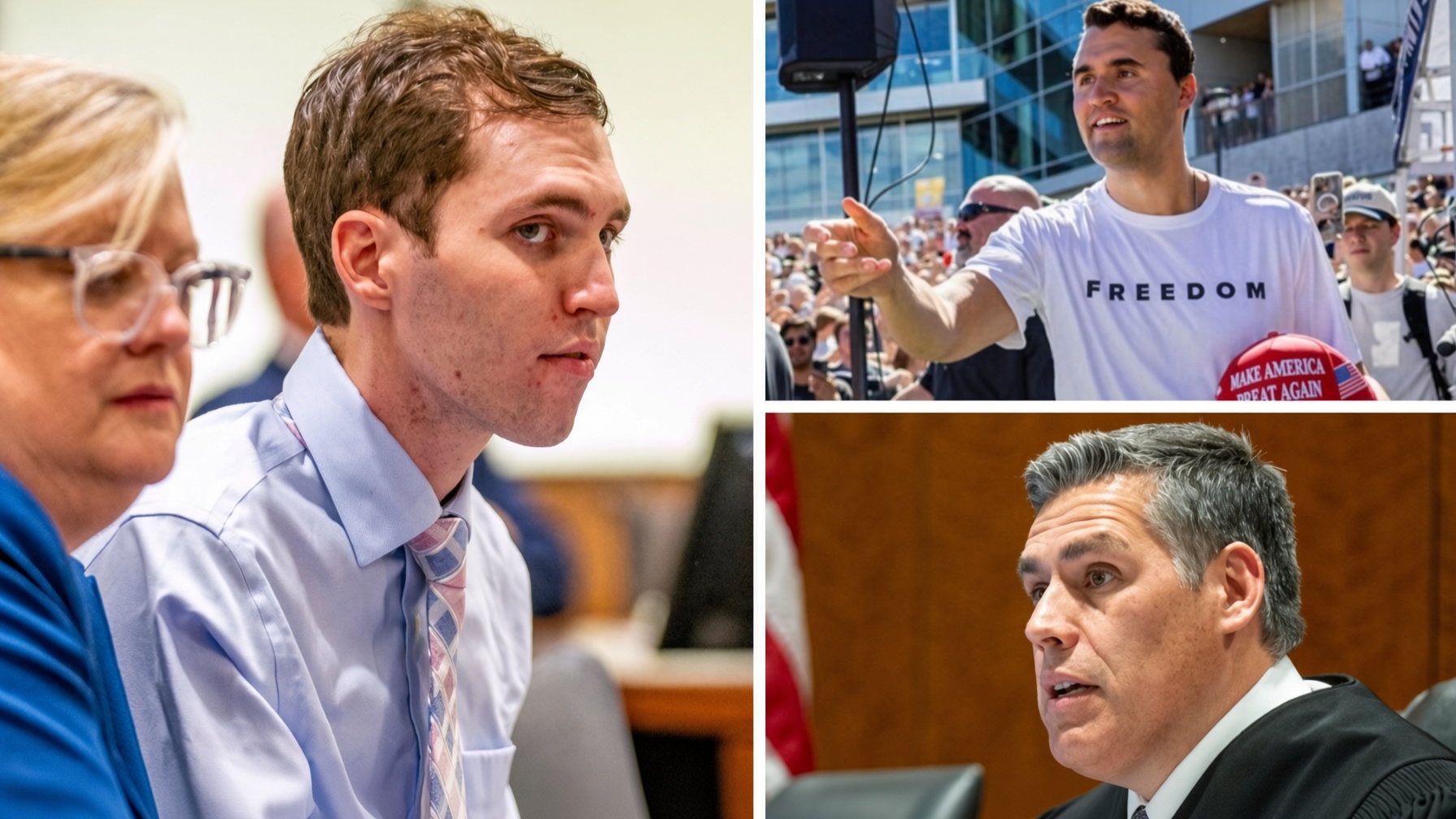
Utah prosecutors delivered a powerful 19-page rebuttal this week, demanding that the man accused of assassinating conservative icon Charlie Kirk face every single charge and remain fully eligible for the death penalty.
In a filing submitted Tuesday, the state urged Judge Tony Graf to reject Tyler Robinson’s latest bid to gut the capital case and instead bind him over for trial on all counts stemming from the September 10, 2025, shooting at Utah Valley University.
Robinson, 23, is charged in connection with the fatal sniper attack on Kirk, 31, the founder of Turning Point USA, who was speaking to a crowd of thousands during his American Comeback Tour when a high-powered rifle round struck him in the neck.
Prosecutors contend the evidence is crushing and that the defense’s attempt to erase the sole aggravating factor—knowingly creating a great risk of death to people other than Kirk—collapses under scrutiny.
The defense had claimed prosecutors failed to prove the shot endangered anyone beyond the victim.
State attorneys demolished that argument, noting Robinson allegedly used his grandfather’s high-powered rifle and fired toward a massive gathering.
Multiple individuals stood in the line of fire or immediately beside Kirk. Prosecutors dismissed the notion that the bullet simply sailed harmlessly over the crowd, stressing that those near the stage remained squarely inside the “zone of danger” created by the shot.
“The evidence here easily establishes at least probable cause” that Robinson knowingly created a great risk of death to others, prosecutors wrote.
They said the evidence is “more than sufficient to support a finding beyond a reasonable doubt.”
Going further, the filing underscored that Robinson has not even contested the core physical evidence tying him to the crime.
“Defendant does not challenge the substance of the evidence demonstrating that he was the person who crawled to the sniper’s perch on the Losee Building rooftop, fired the fatal shot that killed Mr. Charlie Kirk, hid the rifle in a wooded area, got rid of some of the clothing he was wearing, and told his roommate to delete their texts about the shooting,” prosecutors wrote.
Prosecutors also called out Robinson’s attorneys for what they described as a serious ethical lapse.
The defense relied on a Utah Court of Appeals ruling that the Utah Supreme Court later rejected, yet never informed the judge of the controlling higher-court decision.
“This blatant omission violates counsel’s duty of candor to the court,” prosecutors wrote.
The state’s response also reinforced additional counts, including witness tampering involving Robinson’s roommate—who was instructed to delete incriminating messages—and the charge that Robinson committed a violent offense in the presence of a child.
Prosecutors further highlighted evidence that Kirk was deliberately targeted for his political speech, pointing to a cartridge casing engraved with the words “Hey fascist, catch.”
Kirk, a fearless defender of free speech, traditional values, and America First principles, was gunned down in broad daylight while engaging young people on a college campus.
Conservatives across the nation have watched this case closely, viewing the murder as an attack not only on one man but on the very right of conservative voices to speak without fear of assassination.
Prosecutors’ insistence on preserving the death penalty option reflects a determination that such a cold-blooded, politically motivated killing deserves the ultimate accountability under Utah law.
Robinson has yet to enter a plea.
Judge Graf is scheduled to rule at a September 1 hearing on whether probable cause exists to send the full slate of charges—aggravated murder, firearm offenses, obstruction, witness tampering, and the related counts—to trial.
Until then, the prosecution’s latest filing leaves no doubt: the state intends to hold the alleged assassin fully responsible and keep capital punishment firmly on the table.