The chaos in the Senate caused by Democrats is continuing unabated, which is leading to the inability of Republicans—with the filibuster rule still in place—to pass even the most urgent legislation.
That includes must-have bills regarding military funding.
Senate Democrats staged a rare blockade of the annual National Defense Authorization Act on Tuesday, marking an unusual act of opposition to one of Congress’ traditionally bipartisan bills.
Democrats voted to block a procedural motion on the NDAA, the annual legislation that authorizes funding and policy priorities for the Pentagon and the U.S. military.
GOP critics said Democrats’ move was in rebellion against President Trump.
Many Democrats had already voiced concerns about the bill’s overall spending levels, and opposition intensified following the Trump administration’s renewed military campaign against Iran.
“It’s very disappointing,” Sen. Jim Banks, R-Ind., a member of the Senate Armed Services Committee, told Fox News.
“It’s about supporting our troops, supporting our military, and it’s disappointing when Democrats play games with that,” he continued.
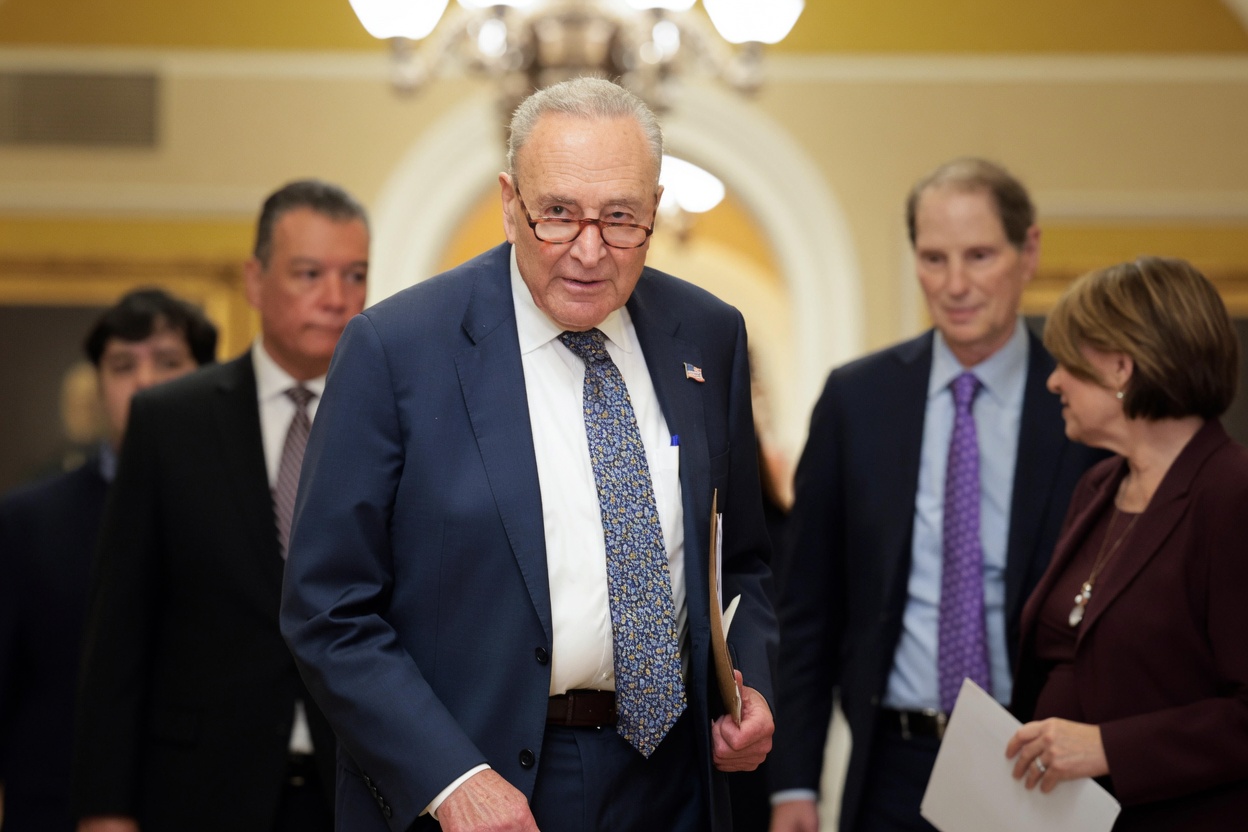
Senate Minority Leader Chuck Schumer, D-N.Y., argued on the Senate floor that Republicans were attempting to move forward with the defense bill “as though none of this is happening,” referring to the issues surrounding the legislation.
“The president is waging an unauthorized war, defying bipartisan majorities in Congress, refusing to level with the American people at the cost of the mission or the endgame,” Schumer said.
“The NDAA cannot become a permission slip for that recklessness that we see occurring in Iran,” he added.
The first indications of trouble for this year’s National Defense Authorization Act emerged during the Senate Armed Services Committee’s vote to advance the legislation, when nine of the committee’s 13 Democrats voted against it.
Sen. Tim Kaine, D-Va., acknowledged that his opposition was unusual.
He said the bill should include additional limits on President Trump’s authority to conduct military operations in Iran and called for a clearer explanation of how the legislation’s roughly $1.15 trillion in authorized spending would be funded.
“The Iran war issue is, I think, one of the major issues about the NDAA, but it’s not the only issue,” Kaine said.
“The absence of knowing where this money is coming from to do this dramatic top-line increase? That still has to get resolved,” he told Fox.
Republicans, however, argued that taking the first step on the bill would allow for an amendment process to modify it.
“It’s pretty frustrating, people need to come together and act in the best interest of the country,” Sen. Rick Scott (R-Fla.), told the outlet.
“We have to, you know, we have to have a strong military,” Scott said.
“Whether we like it or not, people decide to be our enemies. They want to destroy us,” he continued.
“So I think we ought to, you know, get on the bill and if we need to do amendments, let’s start amending it,” Scott added.
Meanwhile, Schumer appears to be gearing Democrats up for another government shutdown, this time right before the midterm elections, though early voting in some states will already be underway.
n a letter to his Senate Democrats on Monday, Schumer falsely claimed that Republicans were “manufacturing a partisan process” for annual spending talks and “accusing Democrats of wanting a shutdown because we refuse to rubber-stamp the result.”
Republicans are “refusing to negotiate on the President’s bloated, partisan topline budget request” for defense, Schumer also claimed – again, falsely, since his party has blocked passage of an amendment to get the bill on the floor for debate and modification.
Congress has a Sept. 30 deadline to fund the government for the 2027 fiscal year and avoid a shutdown, the Washington Times reported.
Trump is urging Senate Republicans to pass another reconciliation bill, which would only require a simple majority rather than the filibuster-proof 60 votes.