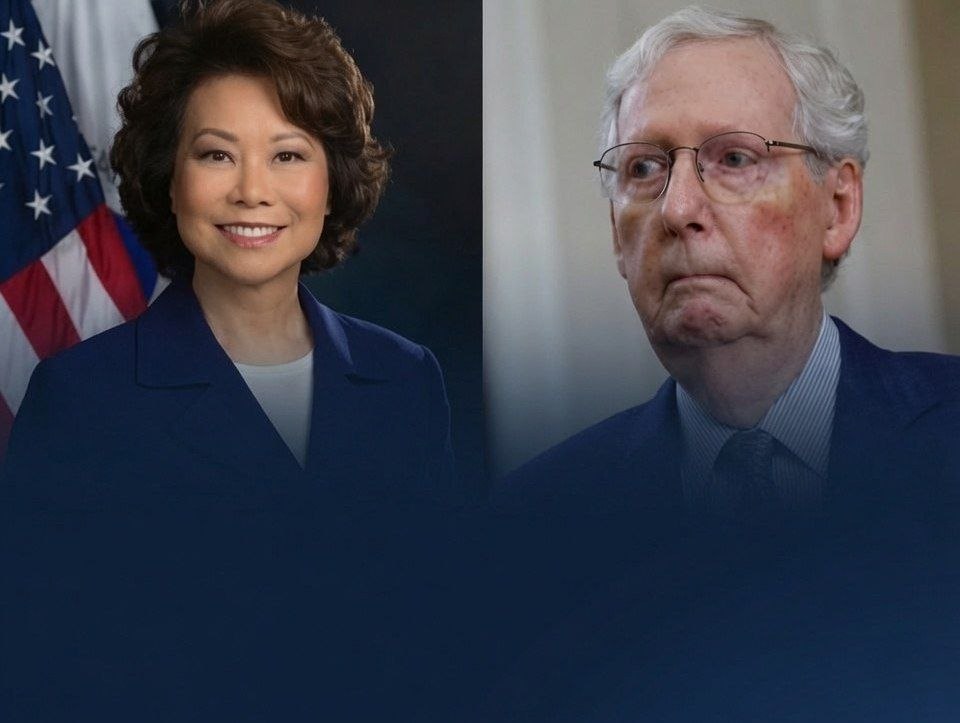
Just days after Sen. Mitch McConnell was hospitalized following a medical emergency at his Washington, D.C., residence, his wife, former U.S. Transportation Secretary Elaine Chao, traveled to Beijing for meetings with senior Chinese officials—a sequence of events that has fueled political scrutiny and renewed questions about the senator’s health.
McConnell, 84, was taken to a Washington hospital on June 14 after emergency responders were dispatched to his home. Since then, limited information has been released publicly about his medical condition. His office has confirmed that he remains under medical care and is recovering, but it has not provided a detailed diagnosis or timeline for his return to public duties.
The lack of detailed updates has prompted speculation from political observers and critics, particularly given McConnell’s decades-long role as one of the most influential figures in the U.S. Senate.
Three days after the senator’s hospitalization, on June 17, Elaine Chao appeared in Beijing for a meeting with Han Zheng, China’s vice president. Images published by Chinese state-affiliated media showed the two seated across from one another during what Chinese reports described as discussions concerning China-U.S. relations and broader issues of cooperation.
Although Chao previously served in President Donald Trump’s Cabinet as transportation secretary, she currently holds no official position in the U.S. government. That fact has drawn attention to the visit, with critics questioning the purpose of the meetings and whether she was acting in any unofficial diplomatic capacity.
Questions surrounding the trip intensified after journalists sought additional information from McConnell’s office regarding Chao’s travel schedule, the purpose of the visit, and whether any coordination occurred with U.S. officials. According to reports, those inquiries did not receive substantive responses.
At the same time, McConnell’s continued absence from public life has fueled debate over the transparency of elected officials’ health disclosures. While Senate leaders are not legally required to release detailed medical records, prolonged uncertainty surrounding the health of senior officeholders has historically generated bipartisan calls for greater openness.
Some medical professionals have cautioned against drawing conclusions without access to McConnell’s medical records. However, emergency physician Dr. Jeremy Faust has publicly commented that patients who require CPR following a cardiac event often face significant recovery challenges, while emphasizing that individual outcomes can vary widely. Because McConnell’s office has not publicly confirmed the exact nature of his medical emergency, outside experts have noted that any assessment remains speculative.
The political implications are already becoming evident. Charles Booker, a Democratic candidate seeking McConnell’s Senate seat, has argued that Kentucky voters deserve greater transparency regarding the senator’s health and his ability to continue serving effectively. Booker contends that public officials entrusted with immense legislative responsibilities should provide clear information when extended medical absences occur.
Supporters of McConnell, meanwhile, have urged patience, arguing that medical privacy should be respected and that speculation should not replace verified information.
As questions continue to mount, attention remains focused on two parallel developments: McConnell’s recovery in Washington and Elaine Chao’s high-profile meetings in Beijing. Whether additional details emerge about either story may shape the political conversation in the days ahead, particularly as concerns over transparency, national security, and the health of senior elected officials continue to dominate headlines.