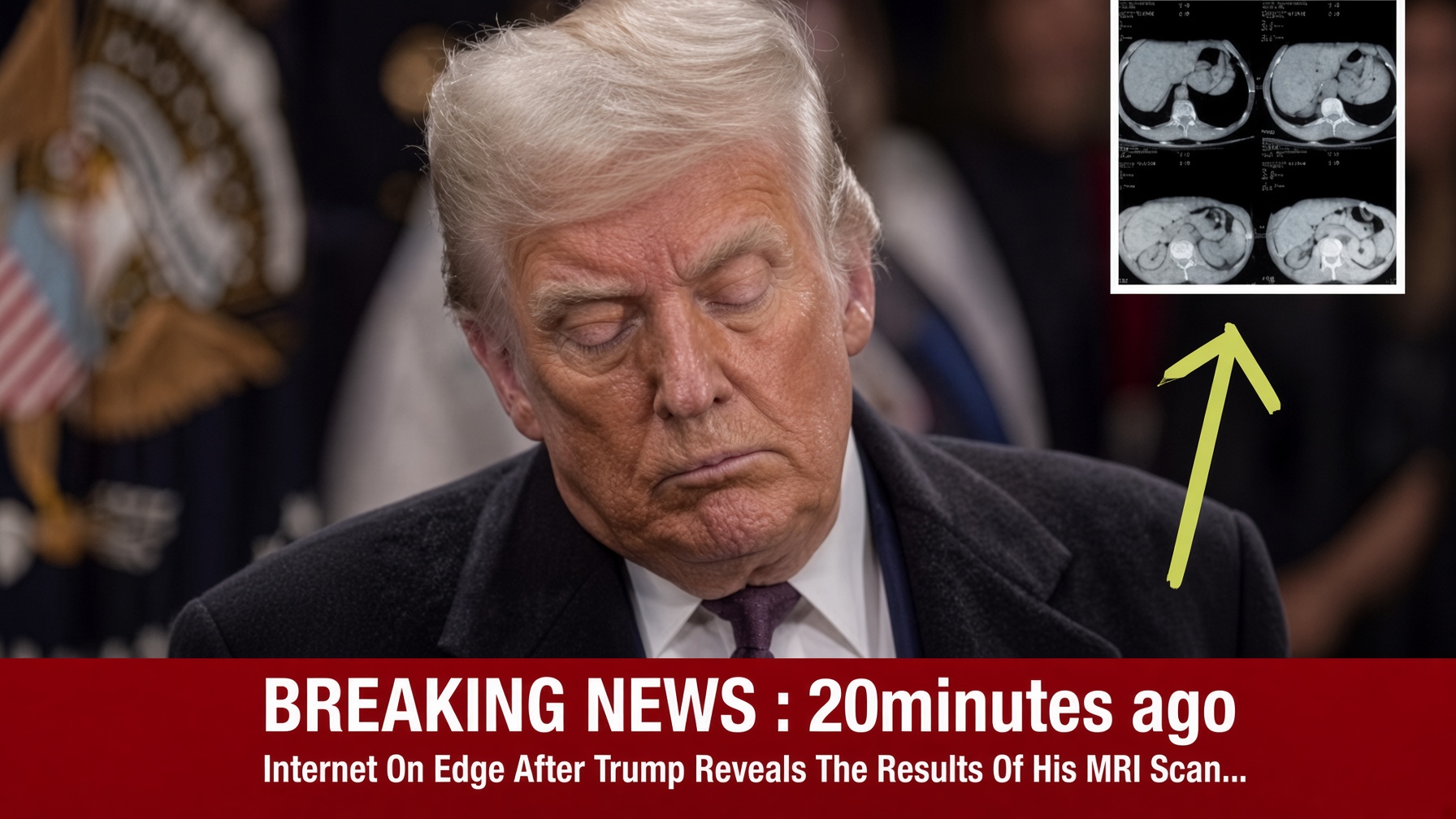
WASHINGTON — President Donald Trump’s casual remarks aboard Air Force One regarding an advanced magnetic resonance imaging (MRI) scan have reignited a perennial national debate over executive health transparency, testing the delicate balance between a commander-in-chief’s personal privacy and the public’s constitutional interest in the physical readiness of the nation’s highest elected official.
The procedure, conducted at Walter Reed National Military Medical Center during what the White House initially characterized as an expanded periodic wellness evaluation in October 2025, drew sharp public attention after Trump lavished praise on the diagnostic outcome while openly acknowledging he was unaware of which anatomical region had actually been scanned.
During an unscripted exchange with traveling reporters in the presidential cabin, Trump repeatedly characterized the findings as “outstanding,” “excellent,” and “perfect.” However, when pressed by correspondents for specific clinical details regarding the necessity and target of the advanced imaging, the president admitted that he had “no idea” what area of his body doctors had examined.
The offhand admission immediately sparked intense scrutiny across Capitol Hill and within the medical community, opening a void of official information that was swiftly filled by political debate, cable news commentary, and digital speculation.
A Delayed Clarification from the White House Physician
Faced with mounting inquiries from the White House press corps regarding whether the scan was ordered proactively or in response to acute, unreported symptoms, the administration moved to stabilize the narrative. In early December 2025, White House physician Dr. Sean Barbabella issued a formal medical memorandum detailing the scope and conclusions of the diagnostic testing.
According to Barbabella’s memorandum, the evaluation was directed specifically toward Trump’s cardiovascular system and abdominal cavity. The physician reported that the multi-sequence scan produced “perfectly normal” results, indicating that the imaging identified no abnormalities in the assessed structures.
Crucially, the clinical summary noted:
Cardiovascular Integrity: The scans revealed no evidence of severe arterial narrowing, vascular calcification, or localized tissue inflammation.
Circulatory Assessment: Imaging identified no signs of active thrombosis, deep venous clotting, or structural abnormalities along major thoracic and abdominal vessels.
Internal Organ Function: No masses, pathological lesions, or functional irregularities were observed within major abdominal organs.
Barbabella presented the advanced imaging not as a reactive measure prompted by a sudden medical event, but as a proactive, preventive diagnostic protocol tailored to comprehensive wellness monitoring. Administration officials reiterated that physicians routinely leverage magnetic resonance imaging to establish baseline physiological data for older adults, particularly those who maintain demanding executive schedules.
However, consistent with long-standing executive branch precedent, the administration declined to release the raw DICOM imaging files, comprehensive lab panels, or unredacted underlying clinical notes. Instead, public documentation remained confined to the physician’s narrative summary and the president’s verbal characterizations.
The Transparency Dilemma in Modern Governance
The episode brings into sharp relief the recurring institutional tension between personal medical autonomy and democratic accountability. Unlike standard civilian medical interactions shielded by strict statutory confidentiality, a sitting president’s health carries immediate implications for national security, economic stability, and the constitutional line of succession.
Independent medical historians and bioethics scholars note that the historical record of presidential health disclosure is fraught with strategic ambiguity. From Grover Cleveland’s covert surgical operation on a yacht in 1893 to Woodrow Wilson’s hidden, debilitating stroke in 1919 and Franklin D. Roosevelt’s concealed cardiovascular decline during his fourth campaign, administrations of both parties have often treated executive medical vulnerability as a liability to be closely managed.
Critics of the administration’s handling of the Walter Reed scan argue that the disjointed rollout created avoidable public unease. Independent health communicators maintain that when an administration discloses high-end diagnostic testing without concurrent technical context, the initial absence of clinical specifics inadvertently fuels speculative reporting. Clear, immediate disclosure regarding clinical indications, they contend, serves as the most effective antidote against uncorroborated digital rumors.
Trump and his political surrogates have forcefully dismissed suggestions that the scan indicated underlying health issues. Emphasizing his grueling domestic travel schedule, regular public appearances, and routine rally performances, the president has maintained that his physical stamina remains robust, framing questions regarding the imaging as partisan overreach.
Navigating Clinical Reality and Public Perception
Medical specialists emphasize that the simple execution of an MRI does not inherently signify pathology. Magnetic resonance technology is widely deployed across clinical practice for routine screening, joint evaluation, non-invasive vascular mapping, and long-term preventive monitoring. In the absence of documented clinical records, outside medical observers cannot definitively extrapolate clinical urgency from the mere utilization of the tool.
Yet the inherent opacity of presidential medical disclosures means outside observers must rely entirely on institutional credibility. While Barbabella’s memorandum provided reassuring clinical findings, the selective publication of physician-curated summaries ensures that skepticism persists among political opponents and transparency advocates, who continue to press for uniform, standardized health disclosure standards for federal executives.
The debate underscores an enduring operational challenge for modern presidencies: how to communicate complex medical information accurately and calmly without compromising individual privacy or creating unwarranted national uncertainty.
For now, the official medical record reflects a normal scan and a clean bill of abdominal and cardiovascular health for the president. Yet as the administration moves forward, the controversy surrounding the Walter Reed scan serves as a reminder that within the pressure-cooker environment of the presidency, even routine diagnostic testing inevitably becomes a national spectacle.