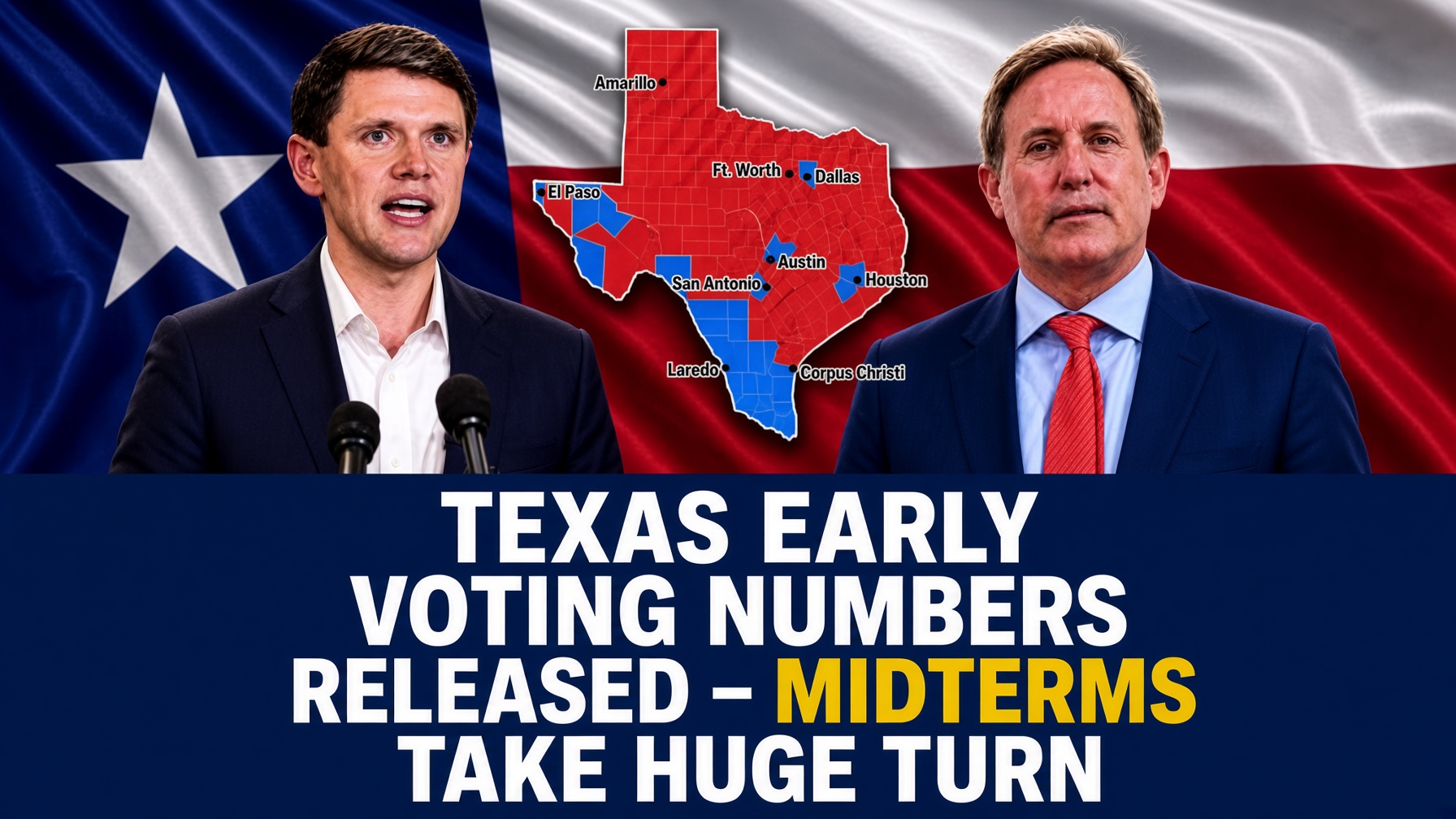
AUSTIN, Texas — Texas Republicans received an encouraging statistical projection during the early voting window, with modeling showing a substantial estimated advantage in the state’s high-stakes U.S. Senate contest. Yet, beneath the veneer of quantitative optimism, internal GOP warfare and a fierce Democratic challenge continue to inject volatility into the race that could define the balance of power in Washington.
According to an October 22 modeling update published by election analyst E DataGuy, more than 2.2 million early and mail-in ballots have been cast across the state. The analytical breakdown classified an estimated 1,216,110 ballots as Republican and 960,966 as Democratic, with an additional 16,263 ballots categorized separately.
The resulting estimated GOP lead of roughly 255,144 ballots was characterized by the analyst as a potential early voting “firewall.” Based on those extrapolated participation trends, the model projected the contest as leaning Republican, forecasting eventual GOP support between 52% and 58%, compared to a Democratic bracket of 40% to 46%, while assuming an eventual statewide turnout of approximately 55%.
The Limits of Early Modeling in Texas
Despite the headlines generated by early vote models, veteran strategists and election observers urge caution when translating returned envelopes into certified outcomes.
Crucially, Texas does not register voters by political party. Because election officials record voter participation rather than candidate selection, private models must rely on secondary indicators—such as primary voting history, demographic profiles, and commercial modeling algorithms—to estimate partisan preferences. Consequently, returned ballots establish who showed up, not which candidates received their votes.
Furthermore, statistical discrepancies highlight the predictive limits of early modeling. The three displayed categorical totals in the graphic sum to 2,193,339 ballots—leaving an unaccounted differential of 15,322 votes from the reported statewide aggregate of 2,208,661. With in-person voting continuing and millions of ballots expected on Election Day, any early advantage remains fluid and subject to late-breaking shifts in turnout velocity.
A Generational Clash for a Coveted Seat
The intense focus on early participation centers on the fierce clash between Republican Attorney General Ken Paxton and Democratic State Representative James Talarico in the November 3 general election. The race will determine who succeeds the state’s retiring senior senator in an increasingly contentious congressional cycle.
Texas Democrats have spent three decades in the electoral wilderness, having failed to capture a statewide office since 1994. However, Talarico, an energetic progressive lawmaker with significant grassroots appeal, has run an aggressive, well-funded campaign aimed at mobilizing suburban moderates, young voters, and disaffected Republicans alienated by Paxton’s extensive legal controversies and hardline rhetoric.
Republicans, for their part, have leaned heavily on the state’s traditional conservative infrastructure, mounting an extensive ground game to communicate with rural strongholds and lock down reliable voters before polls close. While the state’s historical political leanings favor the GOP, the margin of error has narrowed considerably over recent cycles.
Trump Preemptively Blames Cornyn and Rove
Adding acute friction to the contest’s final stretch, President Donald Trump delivered an extraordinary public warning on Monday, preemptively assigning blame to senior Republican figures should Paxton fall short on Election Day.
In an unsparing post on Truth Social, Trump directed his fire at incumbent Republican Sen. John Cornyn and veteran conservative strategist Karl Rove, accusing both establishment figures of undermining the party’s nominee. Cornyn was ousted by Paxton in a bruising Republican primary earlier this year following Trump’s high-profile, contentious endorsement of the attorney general.
“If Ken Paxton loses, it will be because of WEAK and INEFFECTIVE Political Hacks like John Cornyn and Karl Rove, who have ineffectively opposed me for my entire political career,” Trump wrote.
Trump alleged that Cornyn and Rove are “doing everything possible to make it hard” for Paxton to prevail against Talarico. The broadside highlights the unresolved divisions within the Texas GOP, where traditional establishment conservatives remain uneasy with Paxton’s brand of populist nationalism and the contentious circumstances surrounding his primary triumph over Cornyn.
Torrent of National Capital Floods Campaign
The race is also serving as a central theater for an unprecedented flood of national political capital.
Trump’s flagship political action committee, MAGA Inc., entered September with nearly $416 million on hand and has since deployed approximately $277 million to bolster Republican candidates nationwide. The expenditures include massive financial transfers to allied independent-expenditure organizations, including $200 million routed to the No Going Back PAC and $25 million directed to the Safety and Affordability PAC, which have blanketed critical House and Senate battlegrounds with political advertising.
Despite that aggressive capital deployment, MAGA Inc. reported holding over $164 million in cash reserves as of mid-October, bolstered by seven- and eight-figure contributions from prominent billionaires including Steve Wynn, Diane Hendricks, and Stephen Schwarzman. Trump has pledged that his broader political network will deploy more than $400 million overall by Election Day across media buys, voter contact operations, and targeted turnout rallies.
On the legislative front, the National Republican Congressional Committee announced raising $50 million during the third quarter of 2026, entering the home stretch with $61 million in liquid reserves. While those funds are primarily earmarked for competitive House districts, the heavy investment in statewide turnout operations provides downstream operational momentum.
Democrats have responded in kind. Talarico’s campaign has posted historic fundraising figures of its own, backed by a sprawling national donor network and coordinated expenditures from national party committees intent on making Texas competitive.
As early voting counts climb past the two-million mark, the race stands as a defining referendum on Texas’ political future—testing whether modeled Republican firewalls can withstand internal party civil war and a determined Democratic surge.