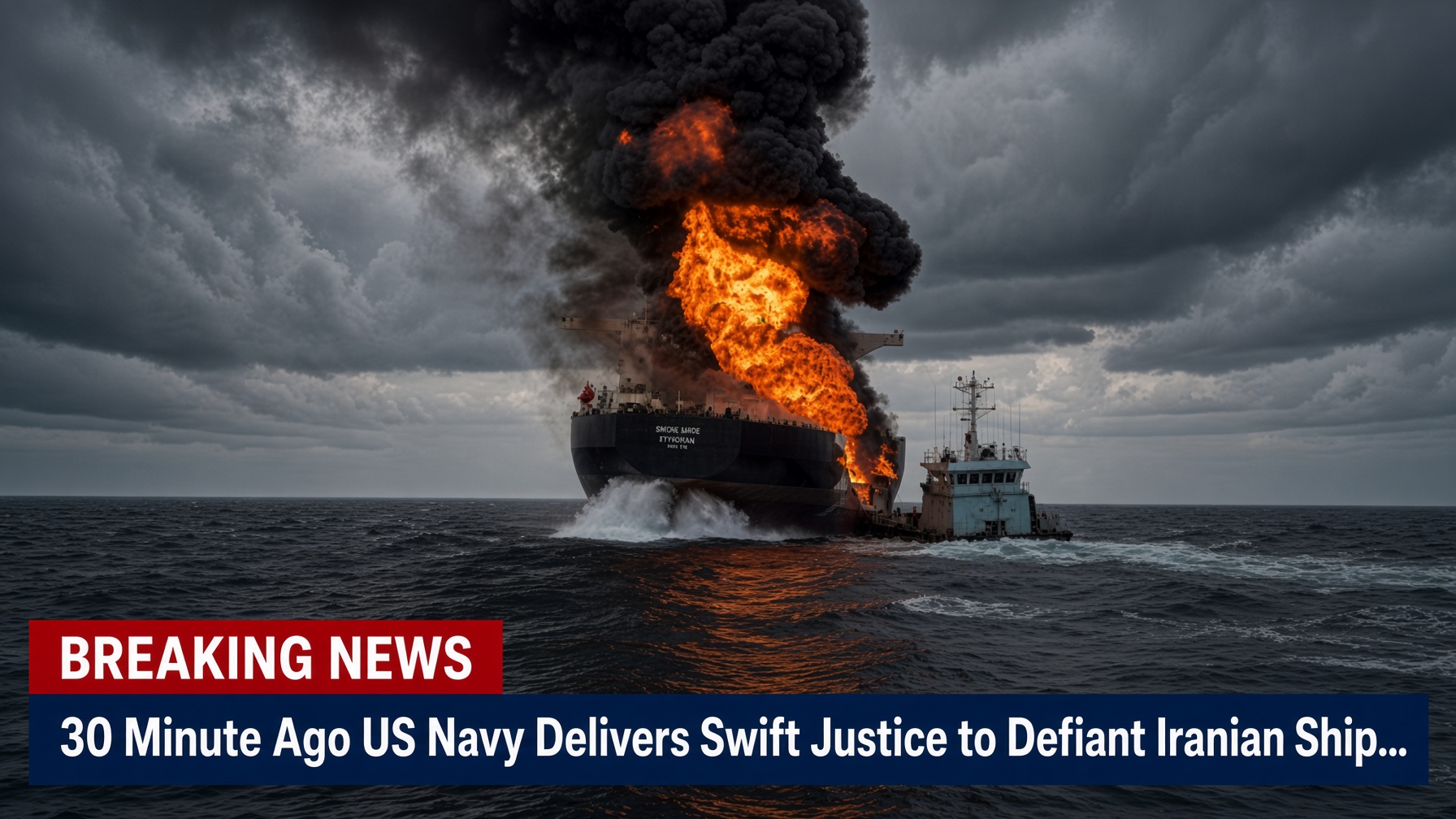
WASHINGTON — Viral social media claims alleging that a U.S. Navy guided-missile destroyer intercepted and disabled an Iranian commercial vessel in the Gulf of Oman have triggered sharp scrutiny across naval monitoring channels, though defense authorities and maritime tracking bodies have issued no official confirmation of the reported clash.
The unsourced accounts, which spread rapidly across digital platforms, detailed an alleged six-hour standoff between the Arleigh Burke-class destroyer USS Spruance and an Iranian-flagged merchant ship operating near the entrance to the Strait of Hormuz. According to the viral narrative, the commercial vessel repeatedly defied navigational instructions and formal warnings before American forces delivered kinetic warning shots that reportedly disabled the ship’s propulsion systems.
However, neither the U.S. Navy, U.S. Naval Forces Central Command (NAVCENT), nor the Department of Defense has released any statement indicating that an engagement of this magnitude occurred.
Detailed Claims Lack Evidentiary Support
The circulating posts presented an unusually granular narrative of the alleged high-seas interdiction.
According to the claims, the Iranian cargo ship rebuffed multiple radio challenges from the USS Spruance over a six-hour pursuit in international waters. The posts asserted that the American warship escalated to warning fire with its forward 5-inch/62-caliber naval gun, scoring a direct hit on the vessel’s auxiliary machinery spaces to immobilize the hull. The accounts added that a maritime interdiction team comprised of U.S. Marines subsequently boarded and secured the disabled ship without encountering armed resistance.
Several variations of the viral post characterized the alleged seizure as an assertive enforcement action sanctioned by the White House to crack down on covert maritime traffic, with some accounts claiming the vessel remains detained under American naval escort.
Despite the technical terminology and chronological pacing woven into the claims, independent verification remains non-existent. Commercial automated identification system (AIS) transponder databases tracking commercial traffic through the Gulf of Oman showed no emergency distress beacons, abrupt course diversions, or lingering exclusions matching the coordinates and timeline provided in the posts.
Institutional Silence from Naval Commands
The decisive flaw in the circulating story is the complete absence of corroboration from official military and diplomatic institutions.
The Pentagon regularly releases prompt declassifications and operational communiqués following live-fire engagements or ship seizures in the Middle East, particularly when operations involve maritime interdiction and boarding teams. U.S. Fifth Fleet headquarters in Manama, Bahrain, which oversees maritime operations in the region, has made no reference to the USS Spruance engaging in live-fire maneuvers against commercial shipping.
Similarly, maritime risk agencies, including the United Kingdom Maritime Trade Operations (UKMTO) and the International Maritime Bureau, issued no alerts or advisory notices to commercial mariners regarding an active interdiction incident near the Strait of Hormuz.
While operational secrecy or temporary communication blackouts occasionally shroud active special-warfare maneuvers, a kinetic engagement involving a prominent surface combatant and the physical disabling of a flagged merchant vessel cannot easily remain concealed within one of the world’s most heavily monitored maritime waterways.
Strategic Volatility Along the Hormuz Corridor
The unvetted narrative gained rapid traction largely due to the severe, ongoing geopolitical tensions defining the Gulf of Oman. As the primary maritime gateway connecting the Persian Gulf with global crude markets, the Strait of Hormuz and its adjacent waters remain perpetual flashpoints for state-on-state confrontation.
In an environment marked by heightened naval alerts and volatile standoff postures, unverified rumors of kinetic encounters carry profound real-world consequences:
Commercial Shipping Anxiety: Unsubstantiated reports of naval fire directly roil international shipping syndicates, prompting immediate inquiries into safe transit corridors and spiking short-term war-risk insurance premiums.
Information Warfare Hazards: Fabricated tactical claims can be weaponized by state and non-state actors to manipulate public perceptions, test adversary reaction times, or generate pretext for legitimate military posturing.
Algorithmic Escalation: Social media aggregators often prioritize engagement-driven military drama over verified fact-checking, amplifying speculative posts into regional trending topics before defense analysts can examine primary data.
Maritime intelligence researchers emphasize that granular narratives and dramatic claims cannot serve as substitutes for primary documentation. Until verifiable radar telemetry, official battle-damage assessments, or formal Defense Department briefings emerge, the claimed interception remains an uncorroborated social media artifact rather than documented naval history.