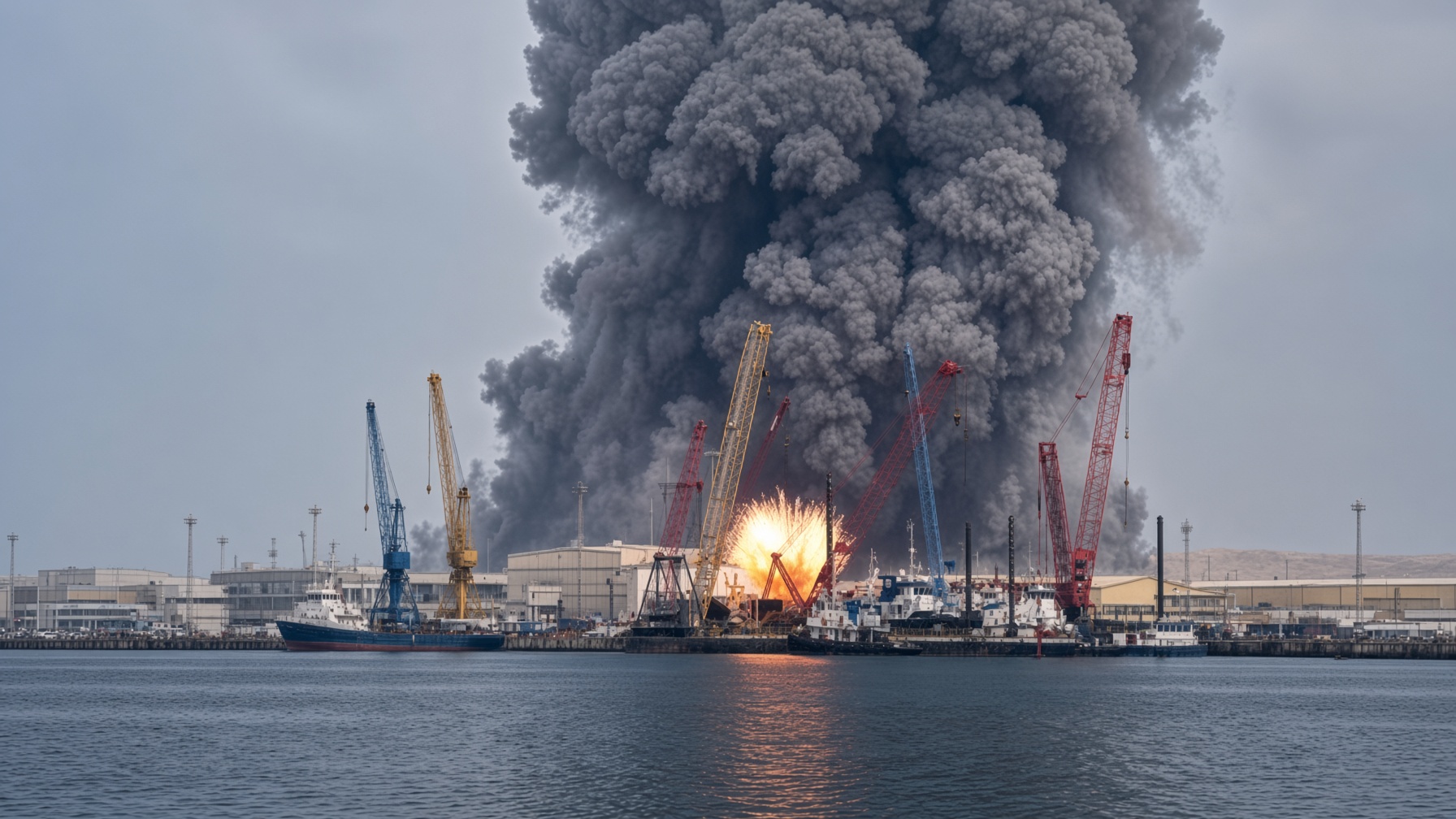
MANAMA, Bahrain — The Persian Gulf has once again pivoted toward an open war footing as Iranian armed forces launched coordinated, multi-axis salvos of medium-range ballistic missiles and one-way attack drones toward strategic installations hosting United States military personnel throughout the region. The widespread bombardment forced allied Gulf capitals into emergency defensive postures, triggered continuous surface-to-air missile engagements, and sent blaring civil-defense alerts across communities already braced for unconstrained escalation.
The offensive underscores a decisive breakdown of localized containment. What once played out through covert maritime skirmishes and calibrated border friction has metastasized into an overt theater-wide campaign. Washington maintains an expansive military architecture distributed across Bahrain, Qatar, Kuwait, and the United Arab Emirates; as Tehran accelerates its asymmetric retaliation, those forward installations and the sovereign nations hosting them have landed directly on the tactical frontline.
In the United Arab Emirates, audible detonations and low-altitude intercepts reverberated near major urban centers as regional early-warning networks tracked incoming tracks. Emirati air-defense units—operating layered batteries that include the Terminal High Altitude Area Defense (THAAD) and Patriot PAC-3 platforms—scrambled to engage projectiles breaching national airspace.
Planners focused particular attention on Al Dhafra Air Base, situated south of Abu Dhabi. The sprawling compound serves as an indispensable logistics and tactical hub, housing U.S. Air Force reconnaissance wings, airborne early-warning squadrons, and frontline aerial refueling tankers. While Iranian state media routinely issues claims of high-impact strikes against American infrastructure at Al Dhafra, Western defense analysts and regional authorities emphasized the need for caution, noting that definitive conclusions regarding runway disruption, command-node damage, or structural integrity require independent commercial satellite imagery and certified post-strike assessments.
Multi-Front Offensive Strains Littoral Allies
The Kingdom of Bahrain, situated at the geographical center of the Gulf littoral, remains under exceptional operational strain. The island nation hosts Naval Support Activity Bahrain, the operational headquarters for U.S. Naval Forces Central Command and the U.S. Fifth Fleet, which oversees allied maritime security missions extending across the Persian Gulf, the Red Sea, and the Arabian Sea.
Coupled with airfield operations at Shaikh Isa Air Base, Bahrain represents the strategic nerve center of American naval deterrence in the Middle East. That prominence makes it an inevitable target whenever Tehran broadens its retaliatory doctrine. During recent salvos, Bahraini ground-based missile defenses, operating in tandem with forward-deployed U.S. Navy Aegis guided-missile destroyers patrolling offshore, engaged multiple inbound targets, filling coastal skies with intercept plumes.
North along the Qatar peninsula, Al Udeid Air Base confronted an identical state of alert. As the forward operating headquarters for U.S. Central Command (CENTCOM) and host to the Combined Air Operations Center (CAOC)—the facility that coordinates all combat and surveillance aviation across the Central Theater—Al Udeid remains one of the Pentagon’s most sensitive overseas assets. Independent satellite imagery from prior skirmishes confirmed localized fragmentation damage to external support infrastructure at the perimeter, and coalition personnel were once again ordered into reinforced subterranean shelters as surface-to-air interceptors ignited across the night sky.
Kuwait has likewise found its geographic territory pulled into the missile corridor. Domestic interceptor batteries were forced into active engagements to defend against low-flying drones and ballistic vectors aimed near logistics staging areas that support U.S. Army Central operations and heavy prepositioned gear.
The coordinated strikes expose a stark reality for Gulf Cooperation Council partners: host nations are being compelled to expend high-end, multi-million-dollar interceptor stockpiles to shield their sovereign territory from attacks stemming from an ideological and geopolitical contest they cannot unilaterally resolve.
Economic Peril in the Strait of Hormuz
Beyond the immediate kinetic fallout, the widening barrage poses catastrophic risks to the global macroeconomy, centered entirely on the Strait of Hormuz. Funneling roughly 20 percent of the world’s petroleum transit, the narrow chokepoint sits directly within range of Iranian mobile coastal defense batteries, surface radar arrays, and Islamic Revolutionary Guard Corps fast-attack craft.
The intensifying tempo of missile launches, low-altitude drone intrusions, and coastal alarms has severely choked commercial navigation. International shipping lines and major energy conglomerates have suspended routine maritime schedules, electing to anchor crude tankers outside the Gulf of Oman or reroute vessels along the extended passage around the southern tip of Africa.
Marine insurance syndicates have responded by adjusting war-risk insurance premiums to near-record thresholds, compounding overall shipping overhead and directly inflating refined fuel costs. Energy trading floors in London, New York, and Singapore are tracking the confrontation with extreme volatility; prolonged maritime interdiction or the deployment of naval bottom-mines within the transit lanes would deliver an immediate supply shock to international crude markets, sparking ripple effects across industrial supply chains and global inflation indices.
The Breakdown of Strategic Deterrence
The widening scope of Iran’s ballistic actions demonstrates that Tehran possesses both the logistical stockpiles and the operational willingness to bypass state borders and target American assets across neighboring territories. Concurrently, the heavy concentration of forward-deployed U.S. personnel limits Washington’s capacity to absorb repeated kinetic strikes without executing direct, punishing counter-sorties against launch facilities and command networks.
For allied military commands, the operational priorities remain managing air-defense magazine depths, hardening vulnerable support buildings, and identifying inbound saturation attacks before they challenge terminal defense systems.
For the international community, the regional crisis has entered an exceedingly dangerous phase. With early-warning radars perpetually active and armed interceptors positioned on continuous alert, the margin between calibrated tactical deterrence and an unconstrained regional conflagration has dwindled to negligible margins. A single projectile penetrating an air-defense screen to inflict heavy casualties at a base in Manama, Doha, or Abu Dhabi could instantly overwhelm existing backchannels and push the Persian Gulf into a conflict that defies containment.