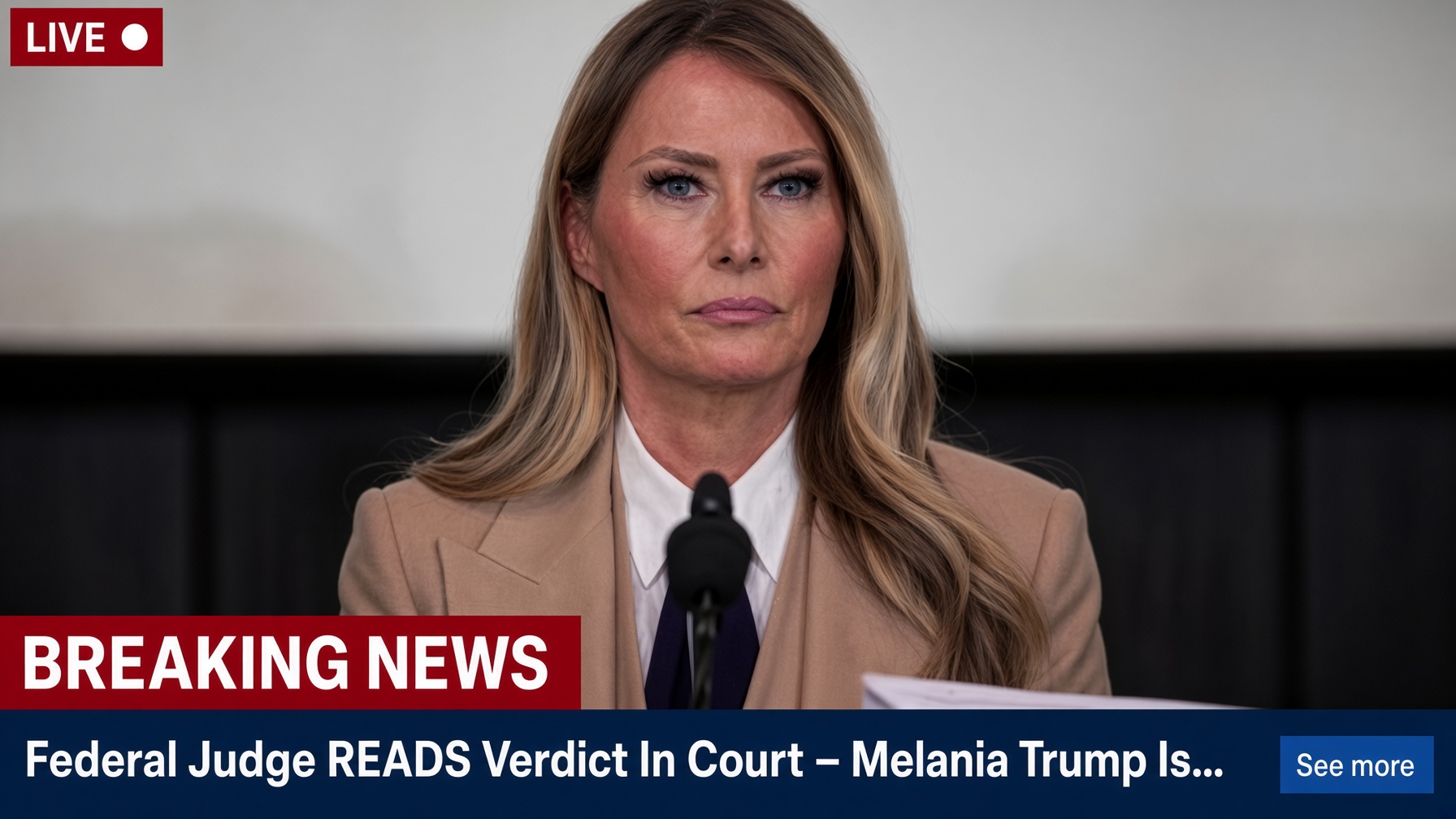
NEW YORK — A federal judge in Manhattan has dismissed an aggressive declaratory-judgment lawsuit brought by author and biographer Michael Wolff against First Lady Melania Trump, refusing to decide ahead of time whether his public commentary linking her to convicted sex offender Jeffrey Epstein constituted actionable defamation or constitutionally shielded speech.
U.S. District Judge Mary Kay Vyskocil of the Southern District of New York issued a detailed 45-page memorandum opinion dismissing the complaint on prudential abstention grounds. The formal judgment was entered in Trump’s favor shortly thereafter. Crucially, the decision offers no substantive ruling on whether Wolff’s assertions were factually false, nor does it establish that they were protected by the First Amendment. It holds simply that Wolff cannot deploy a preemptive federal action to lock in legal immunity before an ordinary tort claim is brought before a jury.
“The plaintiff asks for a declaration that, if the first lady sues him, he deserves to win,” Vyskocil wrote. “That is not how the federal courts work.”
Acknowledging that the litigants “have a real dispute,” Vyskocil held that they “must litigate it according to the same procedures as everyone else.” The jurist characterized Wolff’s preemptive filing as exhibiting an “inappropriate level of tactical gamesmanship,” declaring that the federal judiciary “will not be conscripted to oversee an abusively presented spat.”
The high-profile collision originated after Wolff delivered contentious public remarks concerning Melania Trump’s historical social circle and Jeffrey Epstein, the disgraced financier who died in federal detention in 2019 while awaiting trial on federal sex-trafficking charges. In response, Alejandro Brito, litigation counsel for the first lady, issued an aggressive cease-and-desist demand insisting on a full retraction and public apology. Brito warned that Wolff’s remarks had inflicted “overwhelming reputational and financial harm” and cautioned that Trump would be “left with no alternative” but to file a civil defamation lawsuit seeking up to $1 billion in damages.
Rather than retracting his statements or waiting to be served, Wolff launched an offensive legal strike in New York state court. His complaint sought an affirmative judicial declaration establishing that his commentary was lawful, invoking state anti-SLAPP statutes designed to protect commentary on matters of public interest against retaliatory litigation.
Counsel for Trump removed the matter to federal court under diversity jurisdiction, where the case was docketed as Wolff v. Trump (No. 1:25-cv-10752). While Judge Vyskocil confirmed that federal jurisdiction technically existed—as the opposing parties reside in different states and the amount in controversy exceeds statutory thresholds—she exercised her discretion to decline to hear the action.
Under the Supreme Court’s established Wilton/Brillhart doctrine, federal trial courts retain broad discretion to abstain from issuing declaratory judgments when an underlying dispute can be resolved through conventional litigation. Vyskocil concluded that Wolff’s primary objective was to short-circuit the traditional adversarial process, attempting to win a “race to the courthouse” in New York after Trump had already indicated an intent to file a defamation suit in Florida.
Because the dismissal rests entirely on procedural abstention, the fundamental legal questions remain completely unadjudicated. Nothing in the opinion establishes that Wolff’s claims crossed into defamation, nor does it shield him from liability. Should Melania Trump elect to pursue an affirmative defamation lawsuit, the litigation will proceed under standard procedural burdens—including the rigorous “actual malice” benchmark established in New York Times Co. v. Sullivan, which requires public figures to prove that a defendant published statements knowing they were false or with reckless disregard for the truth.
Wolff’s legal team has appealed the dismissal to the U.S. Court of Appeals for the Second Circuit, docketed as No. 26-1674, arguing that the district court abused its discretion in refusing to shield a journalist facing explicit threats of a ruinous lawsuit. While ancillary sanctions practice continued before the trial court, those post-judgment proceedings do not disturb the core holding: federal judges will not render speculative advisory opinions on the legality of speech before a formal defamation tort is properly joined.
The dispute remains part of a broader, intensely polarized legal clash surrounding public commentary and the Trump family’s historical associations. For now, the ruling serves as an unambiguous procedural reset, ensuring that any future battle over the boundaries of First Amendment protection must be fought as an ordinary civil action.