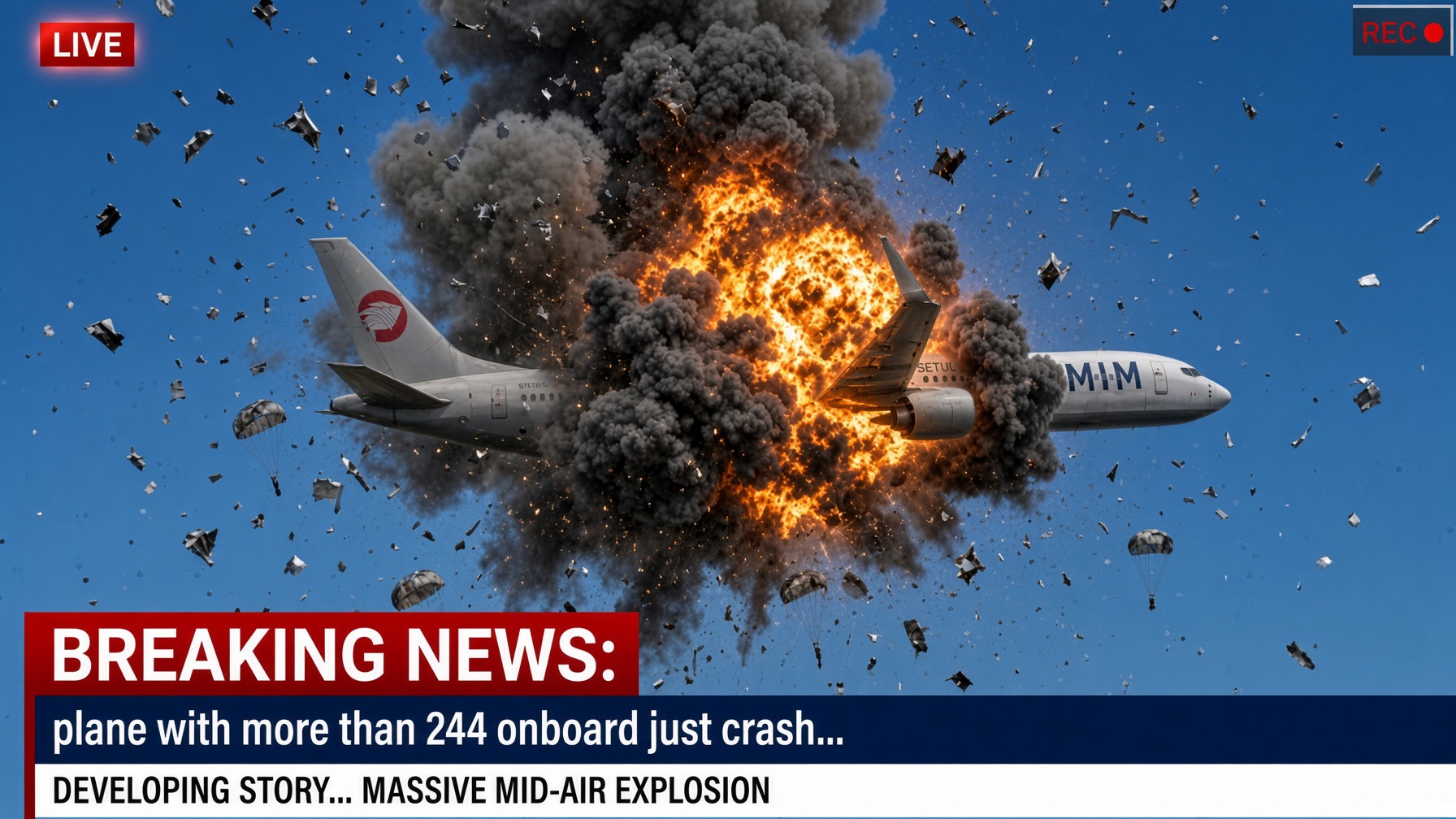
AVIATION DESK — Emergency rescue teams, specialized firefighting units, and federal transportation safety investigators have converged on an active disaster zone following the crash of a commercial passenger aircraft shortly after departure, initiating a sweeping multi-agency response centered on survivor extraction, casualty triage, and scene preservation.
First responders arriving at the perimeter encountered heavy plumes of particulate smoke, ignited aviation turbine fuel, and an extensive debris field spanning several sectors. Municipal police departments, airport emergency apparatuses, and hazardous-materials teams quickly established a multi-tiered security cordon around the impact zone, pushing bystanders back to secure dedicated access corridors for ambulances and heavy firefighting equipment.
While ground teams actively comb through damaged fuselage sections, the operational picture remains fluid. Authorities have refrained from releasing preliminary casualty figures or definitive survival rates, emphasizing that official numbers must await physical sweeps of the wreckage, verification of flight manifests, and cross-referencing with area trauma centers.
Containment Operations Under Extreme Structural Hazards
Industrial firefighting crews deployed aqueous film-forming foam (AFFF) and high-volume water lines to suppress secondary fuel fires and cool the fractured aluminum and composite airframe.
Emergency operations commanders noted that the physical recovery phase presents severe tactical hazards:
Toxic Combustion and Structural Instability: Burning polymer interiors, compromised structural bulkheads, and exposed titanium alloy spars create severe collapse hazards for search-and-rescue teams conducting interior penetration.
Triage Protocols: Regional emergency medical services (EMS) established field casualty collection points to classify victims by injury severity, coordinating air-ambulance transfers and emergency ground transport to trauma facilities throughout the region.
Environmental Mitigation: Specialized environmental units moved to deploy containment booms around adjacent drainage culverts to prevent volatile kerosene fuel from leaching into municipal stormwater systems.
Public safety officials stressed that early estimates regarding occupants and casualties must be treated as provisional, warning that chaotic field conditions and the dispersal of passengers across multiple regional hospitals frequently generate initial discrepancies.
Manifest Audits and Family Assistance Infrastructure
Simultaneously, airline operational dispatchers and civil aviation regulators are conducting an exhaustive audit of the flight’s passenger manifest, electronic boarding gate scans, and crew duty rosters to construct a verified accounting of everyone aboard.
Aviation protocol dictates that airlines and federal transport authorities establish an emergency Family Assistance Center (FAC) to provide centralized, secure briefings to relatives of passengers and crew. Social workers, grief counselors, and specialized disaster-relief personnel are being mobilized to assist families while formal identification procedures proceed under the direction of medical examiners.
Authorities have issued firm warnings against the circulation of uncorroborated victim rosters on social media platforms. Flight safety officials emphasized that formal notifications must follow established legal channels, requiring positive forensic identification—utilizing dental records, personal property, and rapid DNA sequencing—prior to the public release of names.
Independent Investigative Boards Mobilize
As the active firefighting operation transitions to site containment, national transportation safety boards and civil aviation inspectorates have formally assumed jurisdiction over the technical investigation.
A specialized “Go-Team” comprising aeronautical engineers, meteorologists, air-traffic specialists, and powerplant analysts has been dispatched to secure physical custody of the site. The investigative blueprint focuses on three core evidentiary pillars:
Flight Recorders: Locating and retrieving the digital Cockpit Voice Recorder (CVR) and Flight Data Recorder (FDR). Once secured, the “black boxes” will be transported under federal escort to government laboratory facilities for readout and forensic audio-waveform analysis.
Radar and Communications Telemetry: Securing all automated terminal radar tracking files, transponder ADS-B broadcast packets, and radio communications exchanged between the cockpit crew and departure controllers leading up to the loss of signal.
Component Debris Mapping: Utilizing aerial photogrammetry, terrestrial LIDAR scanners, and drone mapping to chart the distribution of engines, control surfaces, and empennage debris. The distribution pattern provides critical clues regarding whether structural failure occurred in flight or upon ground impact.
Safety investigators caution that determining the probable cause of an aircraft accident requires months of methodical testing, including metallurgy analysis, engine teardowns, and flight simulator reconstructions. The inquiry will examine pilot workload, maintenance logs, weight-and-balance manifests, and local low-altitude wind-shear data before issuing an authoritative factual report.
For the duration of the initial response, emergency commands remain focused on securing the site, supporting the families of the victims, and preserving the physical evidence necessary to determine the sequence of events that brought the flight down.