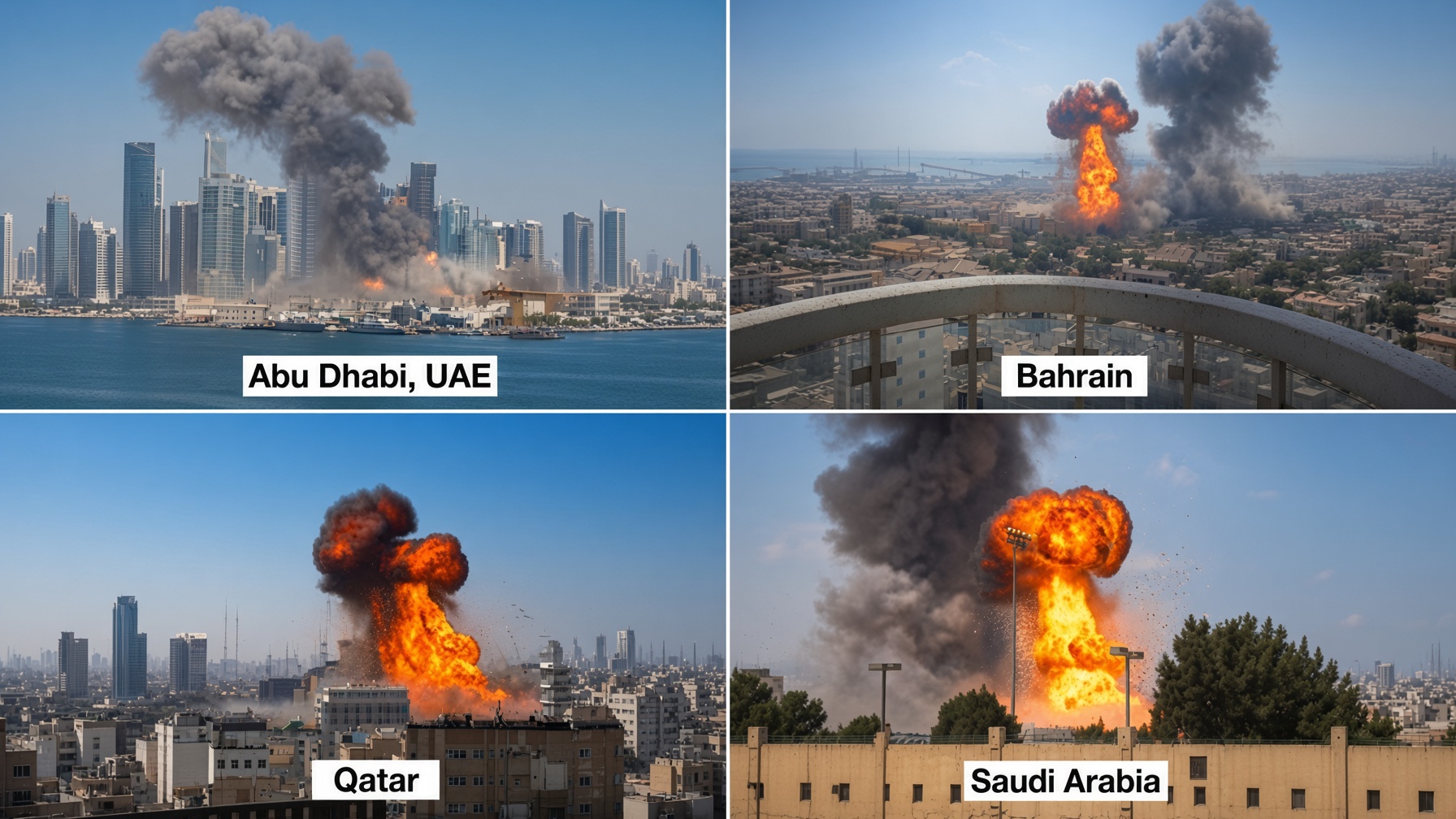
DUBAI / WASHINGTON — Air defense networks across the Persian Gulf were placed on maximum combat alert following a coordinated wave of Iranian ballistic missile and one-way attack drone volleys targeting military installations hosting American personnel across the United Arab Emirates, Bahrain, Qatar, and Kuwait.
The strikes represent a significant regional escalation, testing the limits of integrated theater air defenses and highlighting the profound strategic risks confronting Gulf Cooperation Council (GCC) member states. By hosting major forward-operating hubs for the United States Armed Forces, these nations find themselves positioned directly on the frontline of the deepening military confrontation between Washington and Tehran.
While regional militaries and U.S. Central Command (CENTCOM) moved quickly to activate surface-to-air missile batteries to counter the incoming threats, the operational aftermath remains obscured by strict military information control. Claims issued by state-aligned media outlets in Tehran detailing extensive damage to strategic targets stand in sharp contrast to initial coalition assessments, which indicate that the vast majority of inbound threats were successfully intercepted outside perimeter security lines.
Critical American Bases Targeted Across the Littoral
In the United Arab Emirates, the primary focus of the aerial assault centered on Al Dhafra Air Base, situated south of Abu Dhabi. The sprawling installation functions as an indispensable hub for U.S. Air Forces Central, hosting advanced combat aviation, intelligence, surveillance, and reconnaissance (ISR) platforms, as well as aerial refueling tankers. Terminal High Altitude Area Defense (THAAD) and Patriot PAC-3 batteries stationed in the sector engaged multiple inbound vectors.
While military authorities confirmed that interception debris fell across unpopulated buffer zones, technical crews are conducting runway and radar assessments to rule out structural fragmentation.
Simultaneously, air sirens sounded across the island kingdom of Bahrain, home to Naval Support Activity Bahrain in Manama. The installation houses the operational headquarters of U.S. Naval Forces Central Command and the U.S. Fifth Fleet, which oversees allied maritime security corridors spanning the Red Sea, the Gulf of Oman, and the Arabian Sea. Interceptor units engaged sea-skimming drones and cruise missiles over international waters before they could compromise port facilities, though the sustained threat prompted naval commanders to heighten perimeter force-protection conditions and review warship dispersals.
To the north, installations in Qatar and Kuwait faced parallel saturation attacks:
Al Udeid Air Base (Qatar): Serving as the forward headquarters for CENTCOM, the base hosts the Combined Air Operations Center (CAOC), which coordinates all coalition air activity across the Middle East. Early-warning systems directed personnel to hardened bunkers as layered missile shields engaged incoming trajectories.
Kuwaiti Logistical Hubs: Air defense units stationed near Camp Arifjan and Ali Al Salem Air Base responded to low-altitude drone signatures attempting to penetrate the northern corridor from Iraqi airspace, protecting facilities vital to coalition ground logistics and troop staging.
The Mechanics and Asymmetries of Saturation Strikes
Military analysts observe that the synchronized barrages reflect an intentional doctrine of saturation warfare engineered to exhaust the logistical and economic margins of Western air defense systems.
By launching coordinated swarms of low-cost, delta-wing loitering munitions alongside high-velocity ballistic missiles and low-altitude cruise missiles, attacking forces force defenders to process dozens of competing target tracks simultaneously. The diverse flight profiles present distinct radar signatures, altitudes, and speeds, creating severe target-allocation pressure on automated combat systems.
Furthermore, the exchanges underline a persistent tactical cost asymmetry. Firing multimillion-dollar surface-to-air interceptors—such as the Patriot PAC-3 or the SM-6—to neutralize mass-produced drones costing only a fraction of that figure creates a severe attrition dynamic. Extended engagements risk depleting interceptor magazines faster than commercial defense industrial bases can replenish them, forcing commanders to calculate reserve thresholds while under active fire.
Global Energy Markets on Edge at Hormuz
Beyond the immediate tactical threat to allied garrisons, the expanding perimeter of the missile campaign has injected fresh volatility into international commodity exchanges, centering on the Strait of Hormuz.
The narrow waterway, bounded by Iran to the north and Oman and the UAE to the south, handles approximately one-fifth of global petroleum liquids and significant volumes of liquefied natural gas (LNG). Maritime security agencies have warned commercial shipping operators of heightened electronic interference, spoofed GPS signals, and drone debris falling into international shipping lanes.
Marine insurers have responded by hiking war-risk premiums for crude tankers and container ships transiting the chokepoint, with several international shipping conglomerates considering precautionary halts to convoy movements. Analysts caution that any prolonged operational disruption or kinetic incident involving a commercial vessel in the strait would trigger immediate shocks across European and Asian energy grids, driving up crude futures and complicating global inflation forecasts.
Delicate Balances and Escalation Risks
For the host nations of the Gulf, the barrage crystallizes an acute geopolitical dilemma. While their sovereign defense frameworks rely heavily on the American security umbrella and shared intelligence architectures, becoming launchpads or targets in a regional war carries severe economic and domestic stability risks. Gulf diplomats are privately urging backchannel de-escalation, seeking to prevent their sovereign airspace from serving as an open theater of combat.
For Washington and its regional allies, the immediate imperative centers on replenishing interceptor stockpiles, hardening critical logistics nodes, and maintaining unified deterrence without stumbling into an uncontrolled spiral of retaliatory strikes that could permanently shut down regional commerce.