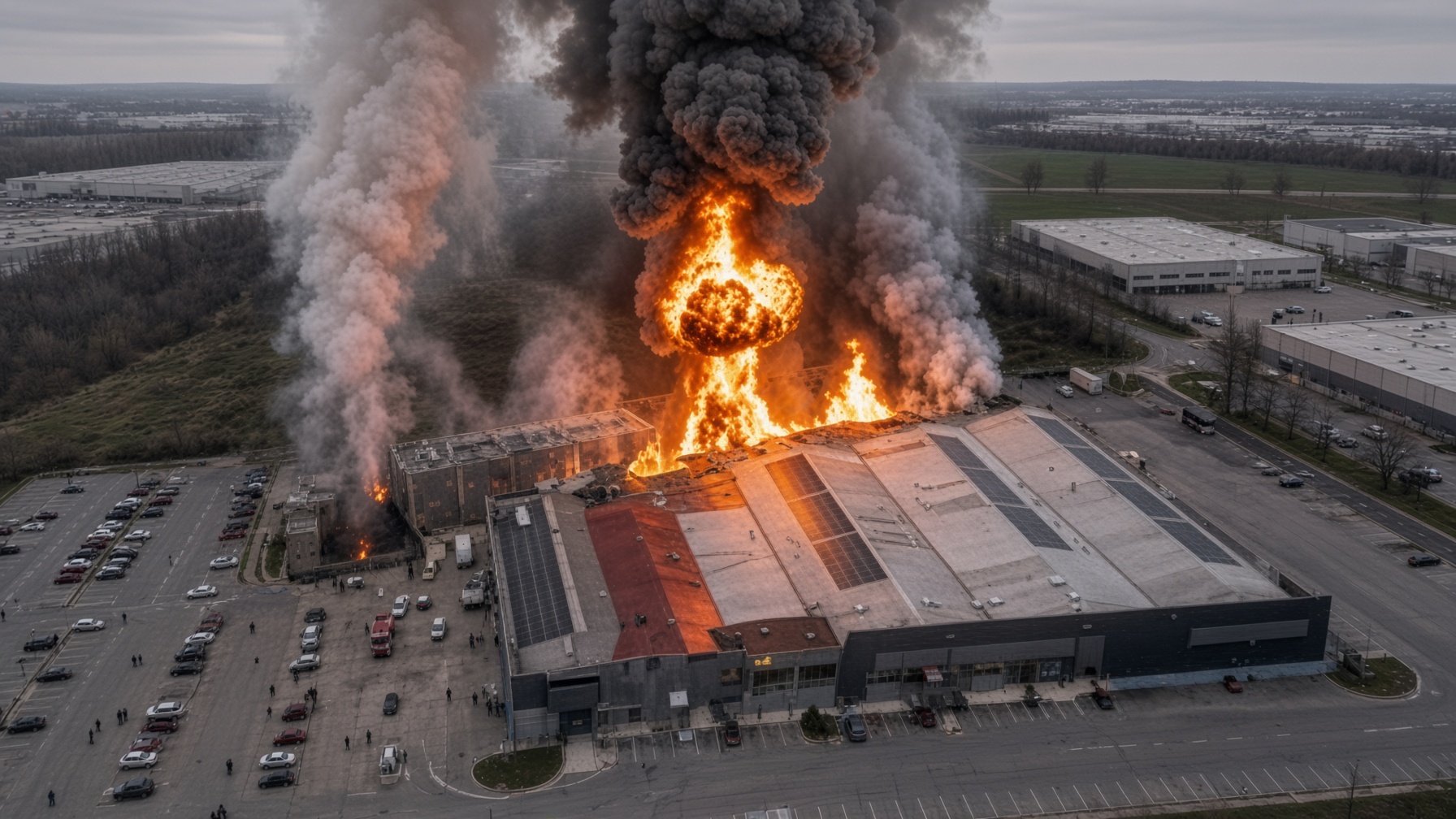
TRIKALA, Greece — A lethal industrial inferno engulfed a sprawling commercial confectionery and biscuit manufacturing complex outside Trikala before dawn on Monday, leaving four night-shift workers dead and seven other individuals hospitalized in one of central Greece’s most devastating manufacturing disasters in decades.
The blaze ignited shortly past 4:00 a.m. local time on the main operating floor of the flagship Violanta bakery facility, situated approximately 200 miles north of Athens along the Thessalian plain. Thirteen production line employees were on duty completing an overnight baking run when an abrupt combustion event spread flames across heavy processing equipment, ceiling insulation, and industrial conveyor belts.
Emergency crews managed to pull eight workers from the facility as dense columns of particulate smoke poured across adjacent farmland. Once suppression units subdued the primary wall of fire, recovery personnel conducted interior sweeps through thermal hotspots, discovering the bodies of four trapped workers. Early concerns that a fifth employee remained lost inside were dispelled when regional authorities reconciled shift manifests with hospital intake logs.
Multi-Alarm Mobilization Under Hazardous Conditions
The Hellenic Fire Service mounted a massive regional response, mobilizing roughly 40 specialized firefighters, 15 pumper engines, and articulated aerial ladders to counter the three-alarm blaze.
First-in units encountered extreme thermal conditions, toxic synthetic combustion byproducts, and structural degradation as steel roof trusses warped under the heat. The structural failure of overhead venting ducts accelerated the draw of oxygen through the facility, generating rolling flames that threatened bulk storage silos. Heavy smoke pushed onto regional thoroughfares, forcing Hellenic Police to close access routes and establish a sterile perimeter around the industrial park.
Emergency medical units transferred seven patients to the General Hospital of Trikala. Among those receiving emergency treatment were six line operators suffering from acute carbon monoxide exposure and thermal injuries, as well as an operational firefighter who suffered respiratory distress while conducting interior rescue maneuvers. Medical directors confirmed that all seven remain hospitalized in stable, non-life-threatening condition.
Judicial and Arson Probes Focus on Mechanical Systems
Regional public prosecutors, working in concert with the Hellenic Fire Service’s Arson Crimes Division and labor safety inspectors, have formally initiated a joint criminal and forensic investigation into the disaster.
Survivor debriefs collected by investigators pointed to a violent concussive shockwave originating near the mechanical dough-kneading and industrial baking lines seconds before fire engulfed the production hall. State forensic specialists cautioned that lab testing must determine whether a localized mechanical or gas explosion sparked the fire, or whether a rapid electrical arc triggered a flash fire among suspended combustible particles.
Technical investigators have initiated a forensic grid inspection of the charred facility, isolating specific systems for testing:
Thermal Ovens and High-Voltage Infrastructure: Examining continuous industrial tunnel ovens, switchgear panels, and high-amperage wiring runs for catastrophic arc faults or breaker failures.
Combustible Dust Hazards: Assessing flour, sugar, and dry ingredient particulate levels, which represent acute deflagration hazards when pneumatic transfer lines rupture near ignition sources.
Firebreak and Damper Integrity: Reviewing whether automated heat and smoke dampers sealed production sectors or failed to arrest the fire’s lateral progression.
Suppression Telemetry: Analyzing computerized control panels and physical water-line manifolds to determine whether overhead deluge systems held sufficient water pressure upon initial sensor trip.
Judicial authorities emphasized that investigators are operating without preconceptions, warning that conclusive findings regarding potential regulatory lapses or mechanical defects will rely entirely on physical evidence recovery and digital surveillance archives.
Corporate Scrutiny and Safety Protocols
Corporate leadership at Violanta issued an emergency statement conveying deep sorrow for the loss of life, stating that internal company resources have been mobilized to provide comprehensive psychological and logistical aid to the families of the victims.
Company executives insisted that the facility operated in compliance with Greek industrial statutes and European Union workplace safety directives, which mandate strict fire suppression zoning, emergency egress redundancies, and scheduled regulatory audits. Independent industrial safety auditors noted that while the survival of eight workers indicates primary egress routes functioned, the swift structural collapse underscores the intense velocity of industrial food manufacturing fires.
The disaster has profoundly shaken the municipality of Trikala, where the bakery serves as a primary regional employer. Regional labor unions and municipal officials have demanded immediate safety reviews across Thessaly’s manufacturing hubs, while state prosecutors move to subpoena the plant’s recent equipment overhaul files, gas line certifications, and occupational safety logs.