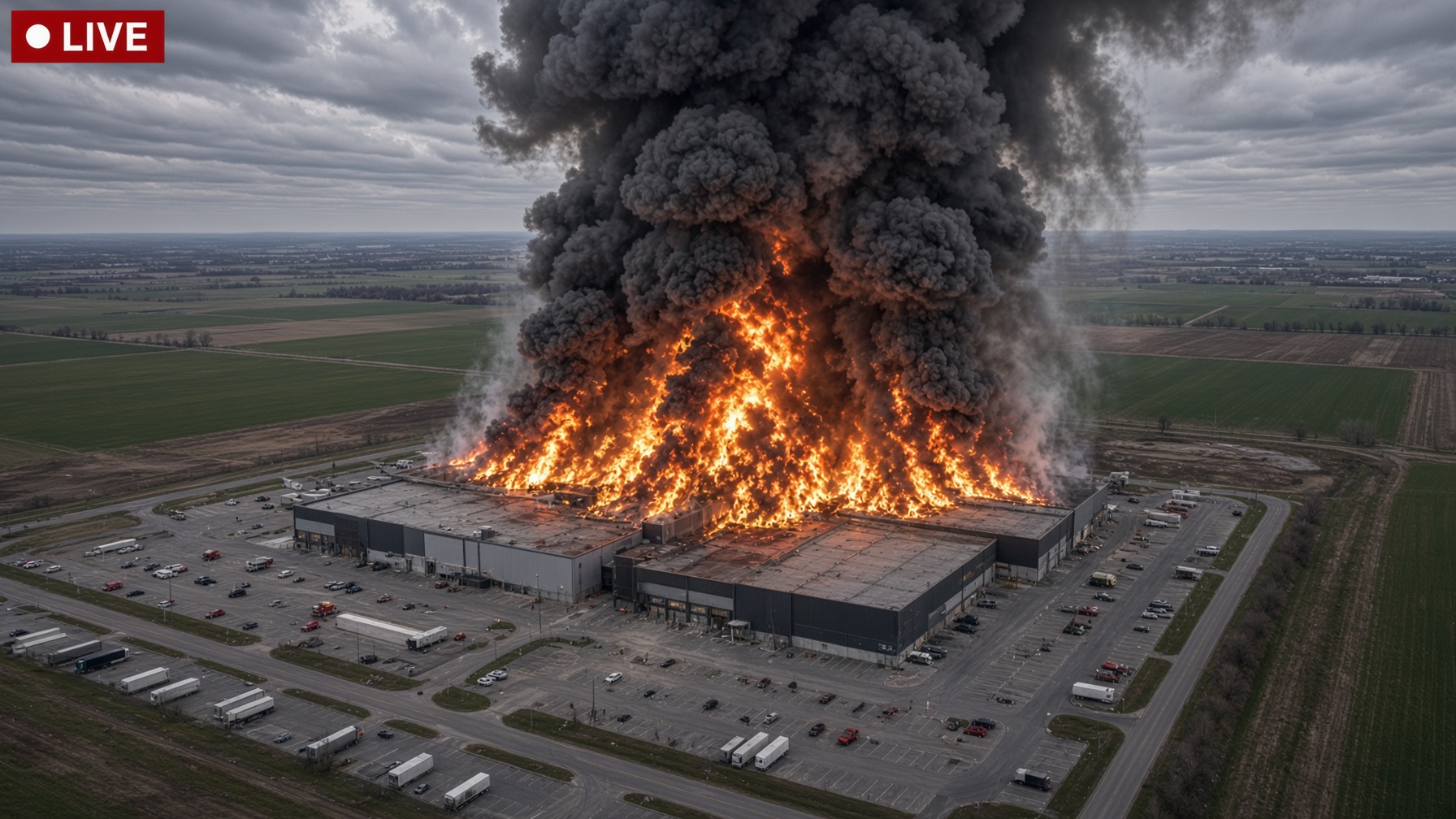
Four Dead in Pre-Dawn Inferno at Violanta Biscuit Factory in Greece, Sparking Nationwide Safety Probe
TRIKALA, Greece — A catastrophic industrial blaze engulfed a flagship commercial bakery outside Trikala in central Greece early Tuesday morning, leaving four night-shift workers dead, hospitalizing seven people, and triggering an urgent, multi-agency investigation into workplace safety practices and industrial compliance across the country.
The deadly incident occurred at the primary manufacturing and packaging facility operated by Violanta, one of Greece’s most prominent biscuit makers and key regional exporters. Located approximately 200 miles north of Athens, the facility serves as a vital economic engine for the agricultural heartland of Thessaly. The sudden destruction has sent shockwaves through the region’s tightly knit industrial workforce.
The Midnight Shift Turns Fatal
The disaster unfolded shortly before 4:00 a.m. during a routine overnight production rotation. Thirteen employees were stationed across the plant floor, operating industrial mixing vats, continuous-heat baking tunnels, and high-speed packaging machinery, when a sudden blast rocked the central processing hall.
Survivors described an almost instant wall of fire. While eight workers managed to flee through perimeter emergency exits amid blaring sirens, four became trapped deep within the facility’s interior. Fast-moving flames, intense thermal radiation, and suffocating clouds of toxic black smoke rapidly compromised primary escape routes.
Specialized search-and-rescue teams from the Hellenic Fire Service entered the burning structure under zero-visibility conditions after exterior crews managed to knock back the initial perimeter fire. Sifting through collapsed steel rafters, buckled conveyor machinery, and smoldering thermal insulation, rescue teams discovered the bodies of the four missing workers several hours later.
Emergency medical teams evacuated seven individuals—six factory workers and one responding firefighter—to regional medical centers in Trikala and Larissa. Attending physicians confirmed that most victims suffered severe smoke inhalation and carbon monoxide poisoning, with several also receiving specialized treatment for second-degree thermal burns. An initial search for an additional missing employee ended late in the morning when hospital registries confirmed their admission.
Two-Front Containment Operation
The Hellenic Fire Service mounted a tier-one emergency response, mobilizing approximately 40 firefighters, 15 tactical engines, and high-reach aerial water platforms to the industrial zone. Upon arrival, first responders encountered advanced structural involvement, with massive flame columns puncturing the roofline and dense smoke threatening adjacent storage structures.
Fire commanders deployed an aggressive, two-pronged tactical defense:
-
Perimeter Defense and Asset Isolation: Crews directed heavy industrial master streams around bulk ingredient silos, natural gas feeds, and commercial refrigeration loops containing volatile chemical agents to avert secondary catastrophic explosions.
-
Interior Rescue and Flashover Mitigation: Breathing-apparatus teams advanced into dense secondary corridors to extract survivors while battling flashover conditions fueled by vast quantities of cardboard, plastic film, and pallet packaging materials.
By mid-day, the incident command transitioned into containment, cooling, and structural shoring. Fire crews deployed thermal-imaging surveillance drones alongside ground teams to locate persistent sub-surface embers buried beneath twisted corrugated metal and concrete slabs, stabilizing load-bearing columns so forensic specialists could safely enter the ruins.
Arson and Forensic Investigators Mobilize
Specialists from the Hellenic Fire Service’s Arson Crimes Directorate (DAEE), accompanied by state forensic engineers and occupational safety regulators, have established a secured command post at the perimeter to determine the root cause of the ignition.
Surviving night-shift personnel told investigators they felt a distinct, low-frequency shockwave an instant before the factory wing lost electrical power and burst into flames. Investigators are focusing on two primary engineering scenarios:
-
Thermal Line or Fuel System Rupture: A catastrophic structural failure involving continuous-tunnel baking ovens, pressurized gas piping, or localized thermal oil delivery conduits.
-
Combustible Dust Deflagration: A spark from mechanical friction or electrical arcing that detonated suspended airborne flour, sugar, or starch particulates, generating a pressure wave that tore through venting ductwork.
Judicial authorities have seized the facility’s digital telemetry, including Supervisory Control and Data Acquisition (SCADA) system logs, automated temperature sensor backups, preventative maintenance files, and intact security camera footage. Investigators stressed that metallurgical examinations of ruptured pipelines and valve assemblies will be required to confirm whether a mechanical failure initiated the blast or was an outcome of extreme thermal stress.
Community Grief and Corporate Response
In an official statement issued Tuesday, Violanta’s executive board confirmed the fatalities, expressed deep sorrow to the victims’ families, and pledged full and transparent cooperation with all investigating authorities.
The company announced the immediate rollout of emergency financial aid, set up dedicated family liaison offices at nearby hospitals, and brought in crisis counselors to assist surviving staff. Violanta, which originated decades ago as a modest neighborhood bakery before growing into an international retail brand, employs hundreds of residents throughout Thessaly, making the tragedy a deeply personal blow to the local community.
Scrutiny Shifts to Structural Defenses
Beyond the immediate technical investigation into the spark that ignited the facility, state prosecutors and labor oversight boards are examining the plant’s adherence to European Union safety regulations and modern fire-compartmentalization mandates.
The inquiry is scrutinizing several critical systems:
-
Suppression Readiness: Whether internal ceiling sprinklers and specialized dry-chemical oven suppressors engaged automatically upon smoke or heat detection.
-
Passive Containment Integrity: Whether automated fire doors functioned as designed to compartmentalize the fire and slow the spread of fatal combustion gases.
-
Emergency Egress Accessibility: The precise factors that prevented four experienced line operators from reaching safety while colleagues nearby escaped.
The Hellenic Fire Service confirmed that official findings will remain sealed until structural debris clearance and forensic reconstructions are fully completed.



