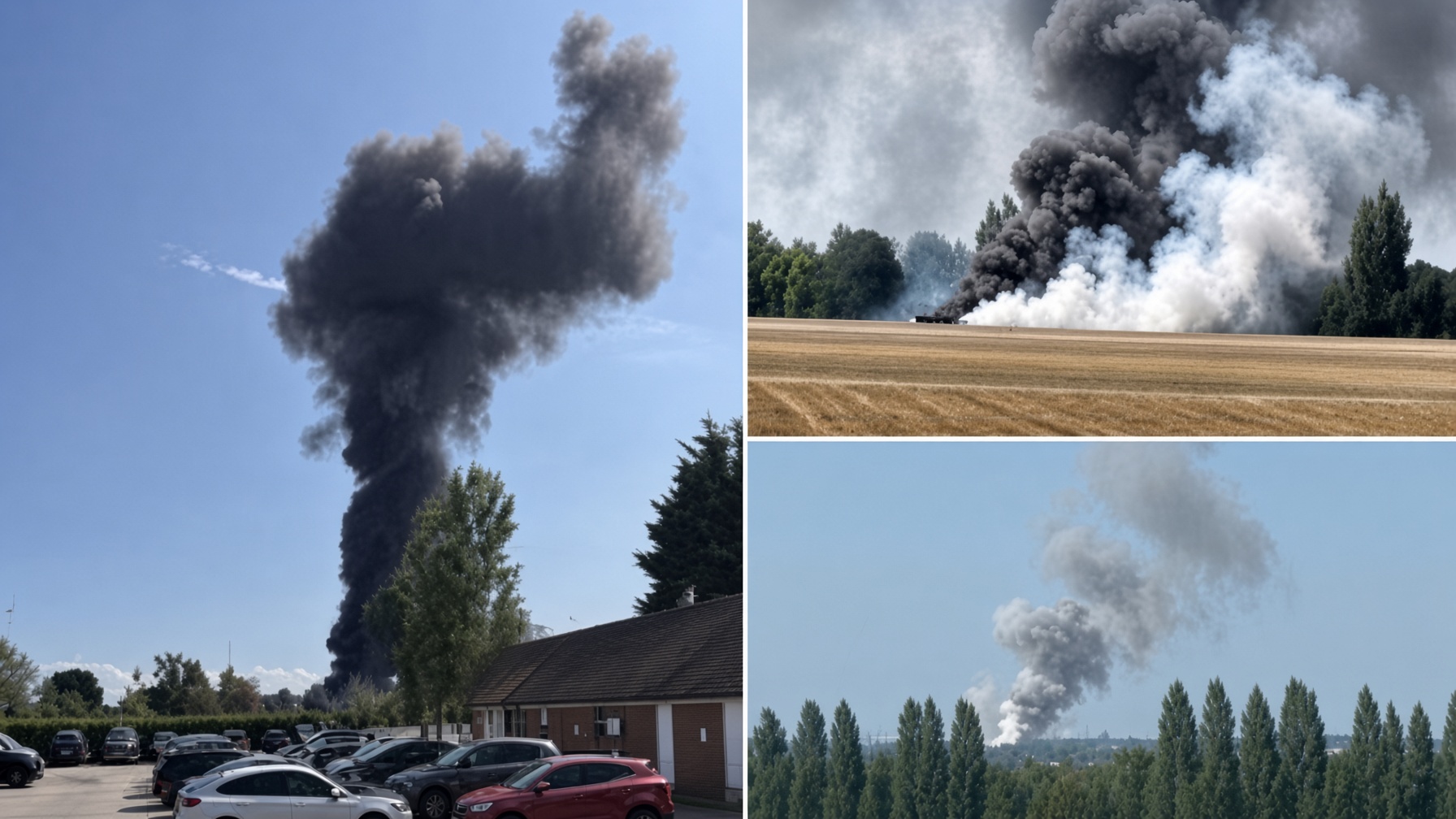
🚨 Miracle in Dubai: Emirates Flight EK521 Crash-Lands With 300 Aboard; Hero Firefighter Dies in the Line of Duty
DUBAI, United Arab Emirates — An Emirates passenger jet carrying 300 people belly-flopped onto the tarmac and burst into flames Wednesday afternoon at Dubai International Airport, triggering a high-stakes emergency evacuation that saw every passenger and crew member escape alive. The miraculous survival of everyone on board was tempered by tragedy, as aviation officials confirmed that a responding firefighter died while battling the raging fuselage fire.
Ten people were transported to local hospitals with non-life-threatening injuries, while aviation authorities, the aircraft’s manufacturer, and international regulators immediately mobilized to determine how a routine international transit descended into one of the most perilous runway accidents in the Gulf carrier’s history.
Seconds From Disaster on Runway 12L
The aircraft, a Boeing 777-300 operating as Flight EK521 from the southern Indian coastal hub of Thiruvananthapuram, touched down heavily at 12:45 p.m. local time (08:45 GMT).
According to passengers on board, the approach had initially felt unremarkable until moments before impact. Several travelers reported that flight deck crew made an announcement warning of an abnormal indication involving the landing gear mechanism, advising passengers to brace for an emergency landing sequence.
Footage captured by onlookers and circulating across social media showed thick plumes of oily black smoke billowing into the midday desert sky above Dubai International Airport (DXB). Eyewitness accounts and airfield video depicted the widebody twinjet sliding along the runway surface on its belly before coming to a halt, followed shortly by a violent ignition and explosion that gutted the upper fuselage and tore away a section of the right wing.
“The cabin crew reacted instantly,” said passenger Iype Vallikadan, recounting the harrowing moments directly after the impact. Emergency escape slides deployed along the aircraft’s flanks as smoke began to penetrate the cabin, and all 282 passengers and 18 crew members cleared the airframe within minutes—a textbook evacuation that aviation safety analysts credit with preventing catastrophic loss of life.
A Hero’s Sacrifice Amid the Response
The successful evacuation turned somber as airport emergency rescue teams confronted the blaze. Sheikh Ahmed bin Saeed Al Maktoum, Chairman and Chief Executive of Emirates Airline and Group, publicly confirmed that an Emirati firefighter lost his life while combating the intense inferno.
“We pay tribute to the firefighter who lost his life fighting the blaze,” Sheikh Ahmed said during a press conference in Dubai. “He was an ultimate professional who sacrificed his life to save others, and our thoughts and deepest sympathies are with his family.”
Sheikh Ahmed confirmed that 10 individuals received hospital treatment for minor smoke inhalation and evacuation-related abrasions, adding that all remaining passengers and airline personnel were safely accounted for and processed through specialized reception centers inside the terminal.
Multinational Manifest
Emirates released a detailed breakdown of the 282 passengers on board the flight, reflecting the extensive labor, business, and transit corridors connecting the Indian subcontinent to the Middle East and onward to Europe and the Americas:
-
India: 226
-
United Kingdom: 24
-
United Arab Emirates: 11
-
Saudi Arabia: 6
-
United States: 6
-
Turkey: 5
-
Ireland: 4
-
Australia, Brazil, Germany, Malaysia, Thailand: 2 each
-
Bosnia and Herzegovina, Croatia, Egypt, Lebanon, Philippines, South Africa, Switzerland, Tunisia: 1 each
Consular representatives and airline liaison officers were dispatched across Dubai to assist travelers with documentation, medical evaluations, and connecting travel arrangements, as many passengers left all personal belongings and travel documents behind inside the burning cabin.
Investigation Focuses on Gear and Weather Dynamics
While full causal conclusions await black box analysis, investigators from the UAE’s General Civil Aviation Authority (GCAA) have launched a comprehensive inquiry alongside technical teams from Emirates and Dubai Airport.
“Our primary concern at this moment remains the safety and well-being of all passengers and cabin crew,” stated Saif Mohamed Al Suwaidi, Director General of the GCAA.
Key technical factors under scrutiny include:
-
Atmospheric Conditions: Meteorological reports around the time of arrival indicated shifting surface winds and sudden wind shear—a violent atmospheric downdraft capable of destabilizing an aircraft’s descent rate. Airline officials acknowledged early indications of wind shear at the airfield, though Sheikh Ahmed stressed it remains too early to definitively cite weather as the primary trigger.
-
Landing Gear Deployment: Investigators will examine mechanical flight logs and physical debris to verify whether the aircraft suffered a partial gear failure, an aborted landing maneuver (go-around), or a premature gear retraction.
-
Manufacturer Technical Support: Chicago-based Boeing confirmed it had assembled an engineering response team ready to assist investigators under the auspices of the U.S. National Transportation Safety Board (NTSB).
Hub Disruption and Operations Recovery
The incident ground operations to an abrupt halt at Dubai International Airport, the world’s busiest international travel hub, which handled over 78 million passengers last year. Inbound flights were diverted across the region to secondary airfields in Sharjah, Al Maktoum International (DWC), and Oman.
Departures faced cascading delays of approximately six hours as airfield maintenance crews worked to foam the crash site, clear debris, and certify adjacent taxiways. Airport authorities announced that scheduled operations began a phased resumption shortly before 7:00 p.m. local time, prioritizing long-haul transfers and critical scheduled routes.
Founded in 1985, Emirates has maintained one of the aviation sector’s most formidable global safety records, with Wednesday’s crash representing the first hull loss in the carrier’s three-decade operational history.



