⚡ Trump Escalates Rhetoric on Iran Ahead of High-Stakes Talks as Maritime Tensions Mount
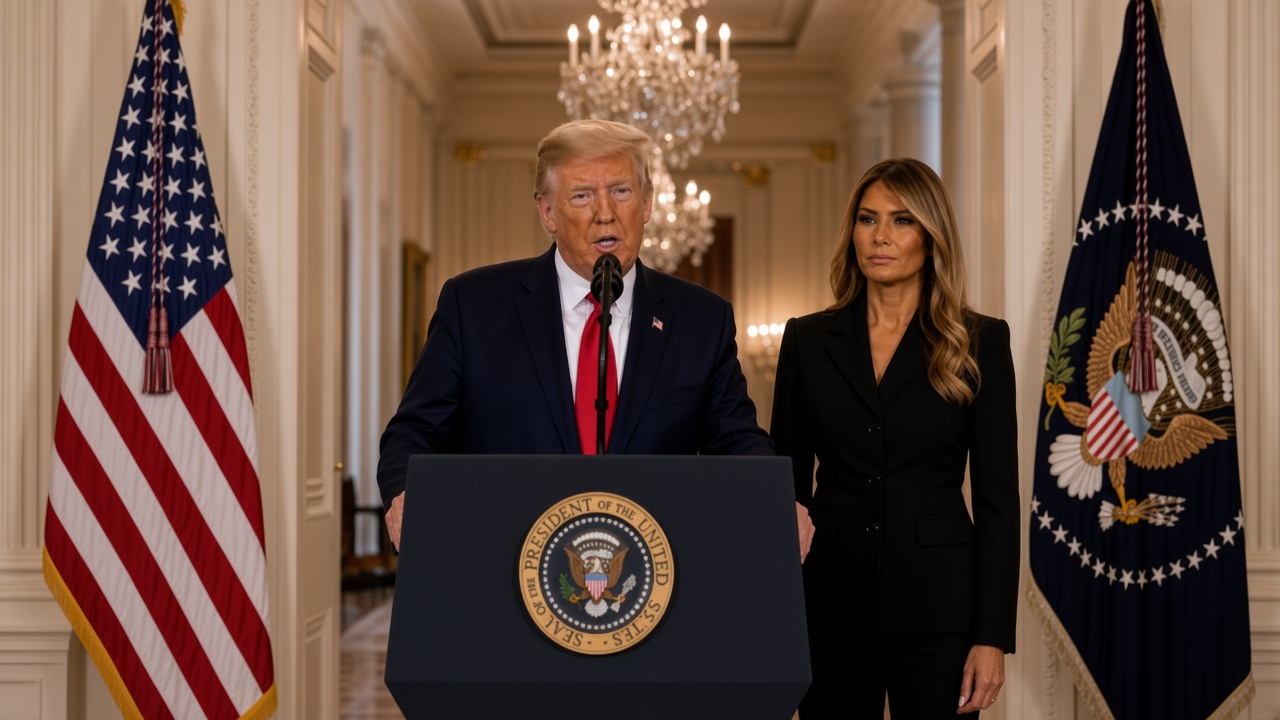
WASHINGTON — President Donald Trump delivered an aggressive assessment of Iran’s military standing on Friday, asserting that Tehran is negotiating from a posture of near-total depletion as high-level diplomatic delegations prepare for critical weekend talks amid persistent reports of cease-fire violations.
In a series of detailed statements posted to Truth Social, Trump warned Iranian leadership against attempting to leverage commercial maritime chokepoints, arguing that recent allied operations have systematically degraded the Islamic Republic’s conventional defense apparatus and maritime denial capabilities.
The rhetoric arrives at a critical juncture: a top-tier U.S. negotiating team is finalizing preparations for face-to-face engagements in South Asia, even as Washington faces fierce domestic debate on Capitol Hill over targeting intelligence, civilian casualties, and maritime security responsibilities.
‘No Cards Left’: The Push for Strategic Advantage
Writing on his social platform, Trump rejected the notion that Tehran retains meaningful leverage at the negotiating table, contending that its remaining posturing amounts to asymmetric extortion along global transit corridors.
“The Iranians don’t seem to realize they have no cards, other than a short-term extortion of the World by using International Waterways,” Trump stated, specifically citing ongoing security concerns in the Strait of Hormuz—the vital maritime artery through which roughly one-fifth of the world’s petroleum consumption passes.
Trump laid out what he characterized as the comprehensive destruction of Iran’s primary combat arms, asserting that allied strikes have neutralized the country’s strategic deterrence:
“Their Navy is gone, their Air Force is gone, their Anti Aircraft apparatus is nonexistent, Radar is dead.”
The president claimed that Iran’s missile and unmanned aerial vehicle (UAV) networks have been “largely obliterated,” while its senior political and military command structures have suffered severe leadership losses. “The only reason they are alive today is to negotiate!” he added.
Addressing the persistent hazard of naval ordnance in the Persian Gulf, Trump dismissed Tehran’s remaining asymmetric maritime threats, asserting that “all 28 of their mine dropper boats are also lying at the bottom of the sea” and that naval forces are actively restoring transit routes.
“We’re now starting the process of clearing out the Strait of Hormuz as a favor to Countries all over the World,” Trump wrote, naming global commercial partners including China, Japan, South Korea, France, and Germany. He added that major commercial tankers are currently en route to North American terminals to stabilize energy inventories.
High-Level Delegations Deploy to Islamabad
The White House’s stern rhetoric comes as an executive-level U.S. delegation prepares for direct discussions on neutral ground.
Vice President JD Vance will lead the U.S. contingent, joined by Special Envoy Steve Witkoff and senior adviser Jared Kushner. The diplomatic team is scheduled to touch down in Pakistan on Saturday for direct talks aimed at enforcing compliance mechanisms, formalizing terms for a sustainable cessation of hostilities, and securing free navigation through international waters.
The inclusion of both Kushner and Witkoff underscores the administration’s intention to tie the security dialogue directly to broader regional stabilization architecture. Regional analysts suggest that Vance’s direct involvement is designed to signal to Tehran that any finalized settlement carries the full, immediate authority of the executive office.
However, regional security analysts note that fragile cease-fires frequently encounter tactical disruptions on the perimeter, with hardline elements testing the perimeter of maritime exclusion zones before high-level envoys finalize terms.
Bipartisan Clashes and Domestic Scrutiny
On Capitol Hill, the escalation of kinetic operations and the trajectory of negotiations have triggered intense political friction.
Appearing on Fox News Thursday evening, Sen. John Fetterman (D-PA) broke with many in Washington’s political class by offering a forceful defense of the administration’s assertive stance, accusing domestic media outlets of giving undue credence to Iranian government framing.
“I can’t speak for my other Democrats, but the American media has, essentially, become — carrying water for Iran,” Fetterman told host Jesse Watters. “And they’re describing the kinds of circumstances, then they forget the way Iran has behaved.”
Fetterman urged lawmakers and commentators to keep Tehran’s destabilizing record across the region in sharp focus:
“Why can’t we just call what Iran has been — and what it continues to do, those things? America is the force of good in the world, and holding Iran accountable, what they’ve done, is important.”
The Pennsylvania senator’s comments follow a series of sharp confrontations regarding military operations, including a tense televised exchange last month on CNN’s The Source with anchor Kaitlan Collins over collateral damage and military precision.
Scrutiny remains intense following the fallout from a Feb. 28 Tomahawk cruise missile strike that struck the Shajarah Tayyebeh educational facility in Minab, southeastern Iran. Iranian regional authorities alleged that the strike resulted in catastrophic civilian casualties, claiming up to 175 fatalities, predominantly school-age children.
A preliminary Defense Department review later determined that the catastrophic strike stemmed from severe targeting errors, citing outdated geographic coordinate data provided by the Defense Intelligence Agency (DIA). The intended operational objective was an adjacent Islamic Revolutionary Guard Corps logistical installation.
As Vance and the diplomatic team land in Pakistan, the White House must now manage a delicate dual-track strategy: sustaining decisive military deterrence across the Persian Gulf while establishing workable diplomatic terms capable of outlasting the immediate crisis.