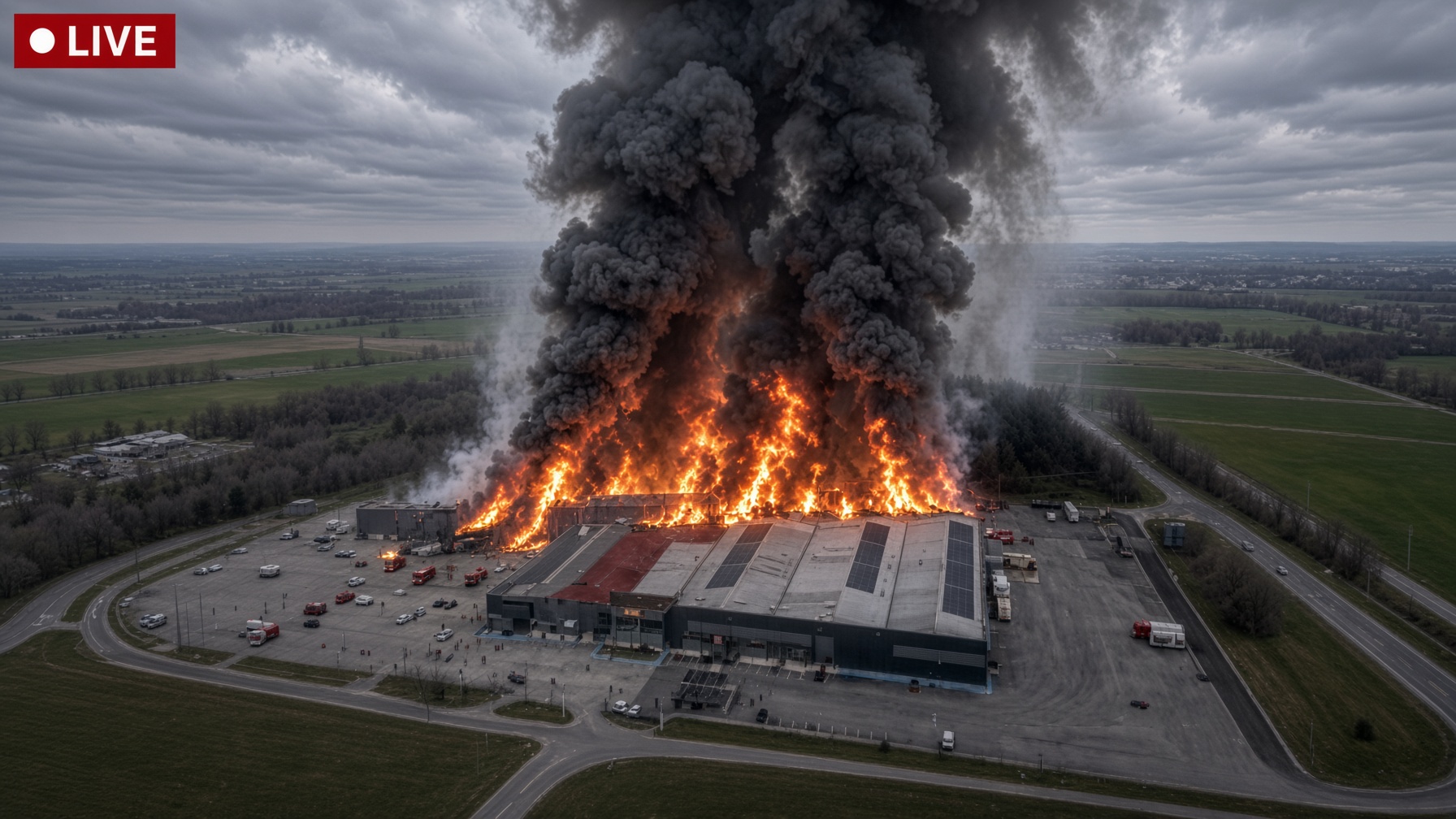
🔥 Tragedy in Thessaly: Pre-Dawn Fire at Violanta Biscuit Plant Leaves Four Dead, Sparking Broad Industrial Safety Inquest
TRIKALA, Greece — A catastrophic industrial fire tore through a flagship commercial bakery outside Trikala in central Greece early Tuesday morning, claiming the lives of four factory workers, hospitalizing several others, and triggering a comprehensive multi-agency investigation into workplace safety systems and industrial compliance.
The incident occurred at the primary manufacturing and packaging complex operated by Violanta, one of Greece’s most prominent domestic and export biscuit manufacturers, situated approximately 200 miles north of Athens. The sudden, violent nature of the fire has cast a pall over the Thessaly region, where the company serves as a vital economic engine and a major employer for surrounding rural communities.
A Deadly Pre-Dawn Incursion
The emergency unfolded shortly before 4:00 a.m. local time, during the facility’s overnight production and packaging rotation. Thirteen personnel were stationed across the plant floor, overseeing automated baking lines and high-speed packaging machinery, when a fire erupted inside the core processing hall.
Initial accounts from survivors indicate the ignition was catastrophic and immediate. While eight employees successfully evacuated through perimeter exits as interior sirens sounded, four workers became trapped deep within the production floor by rapidly propagating flames, intense thermal radiation, and impenetrable plumes of toxic particulate smoke.
Search-and-rescue teams from the Hellenic Fire Service entered the complex under zero-visibility conditions once perimeter suppression crews partially checked the flames. Following hours of sifting through collapsed structural beams, distorted conveyor systems, and smoldering insulation panels, recovery teams located the bodies of four victims.
Seven individuals—six plant employees and one responding firefighter—were transported via emergency medical services to regional hospitals in Trikala and Larissa. Attending physicians reported that the majority suffered from acute carbon monoxide and toxic smoke inhalation, with several sustaining varying degrees of cutaneous thermal burns. An initial search for an additional unaccounted-for worker was resolved later in the morning after shift rosters were cross-referenced with local hospital admissions.
Emergency Response and Containment Operations
The Hellenic Fire Service initiated a high-tier industrial response, dispatching roughly 40 specialized personnel, 15 tactical fire-suppression engines, and high-reach aerial water towers to the industrial park. Upon arrival, first responders encountered heavy structural involvement, with flames breaching the roofline of the processing facility and threatening adjacent warehouses.
Commanding officers established an aggressive dual-vector defense:
Perimeter Containment: Heavy master streams targeted exterior perimeters to insulate industrial chemical refrigeration infrastructure and large-scale bulk ingredient silos, preventing an amplified chemical release or secondary catastrophic explosion.
Interior Sector Operations: Specially equipped breathing-apparatus teams pushed through secondary hallways to locate trapped shift personnel, simultaneously battling intense flashover risks fueled by industrial packaging consumables.
Operations transitioned into a dampening-down and structural shoring phase by mid-day. Thermal imaging drones and ground crews systematically mapped and smothered persistent sub-surface hot spots embedded deep in the debris field, working to stabilize compromised load-bearing pillars so judicial and forensic investigators could secure safe access.
Forensic Inquiry Mobilizes
A dedicated team from the Hellenic Fire Service’s Arson Crimes Directorate (DAEE), joined by regional forensic engineers and labor safety inspectors, has launched an intensive technical inquiry to determine the disaster’s primary point of origin and mechanism of ignition.
Surviving workers interviewed by investigators recounted hearing a sharp, concussive boom immediately before the manufacturing wing was plunged into blackout and consumed by fire. Forensic teams are exploring two primary operational hypotheses:
Mechanical or Gas Event: A sudden failure in the continuous-heat baking tunnels, high-pressure natural gas lines, or thermal fluid delivery loops.
Deflagration and Dust Hazard: A primary mechanical or electrical flash that ignited concentrated organic dusts (such as suspended flour, sugar, or starch particulates) inherent to large-scale baking environments, triggering rapid flame propagation.
Authorities have sequestered the facility’s digital supervisory control and data acquisition (SCADA) logs, routine maintenance archives, automated sensor telemetry, and surviving closed-circuit security camera feeds. Officials emphasized that determining whether the initial concussive sound was the cause of the fire or a consequence of heat-compromised pressure lines will require exhaustive laboratory analysis of the metal deformation and structural debris.
Corporate Response and Community Fallout
In a formal corporate dispatch, Violanta’s executive leadership confirmed the loss of life, offering unreserved condolences to the victims’ families and committing unconditional cooperation to state authorities throughout the ongoing inquiry.
The company stated that executive leadership, alongside human resources and crisis response teams, has mobilized direct emergency financial assistance, established family liaison desks at regional hospitals, and engaged professional trauma counselors to support surviving shift personnel and plant staff.
The tragedy has resonated deeply across Thessaly’s industrial corridor. Civic leaders and regional administrators gathered at the cordoned-off site to express solidarity, pledging municipal support services for the affected households. Violanta, established as a modest local neighborhood bakery decades ago, evolved into an internationally recognized brand and an economic cornerstone for hundreds of local families, making the tragedy a collective community loss.
Broader Industrial Safeguards Under Scrutiny
Beyond the immediate forensic review, regional prosecutors and national labor watchdogs have opened inquiries into the plant’s compliance with statutory European Union workplace safety mandates and structural fire defense directives.
Investigators are closely evaluating key operational defense parameters:
Suppression Activation: Whether automated ceiling sprinkler networks and specialized oven-suppression systems discharged effectively at initial detection.
Passive Safety Architecture: The functional condition and compartmental integrity of designated fire doors intended to arrest the migration of lethal gases.
Egress Integrity: Why four experienced production workers were unable to reach fire escapes while their colleagues escaped, probing whether escape corridors remained clear or became compromised by sudden structural failures.
The Hellenic Fire Service affirmed that formal findings will remain confidential until forensic reconstruction and physical debris analysis are concluded.