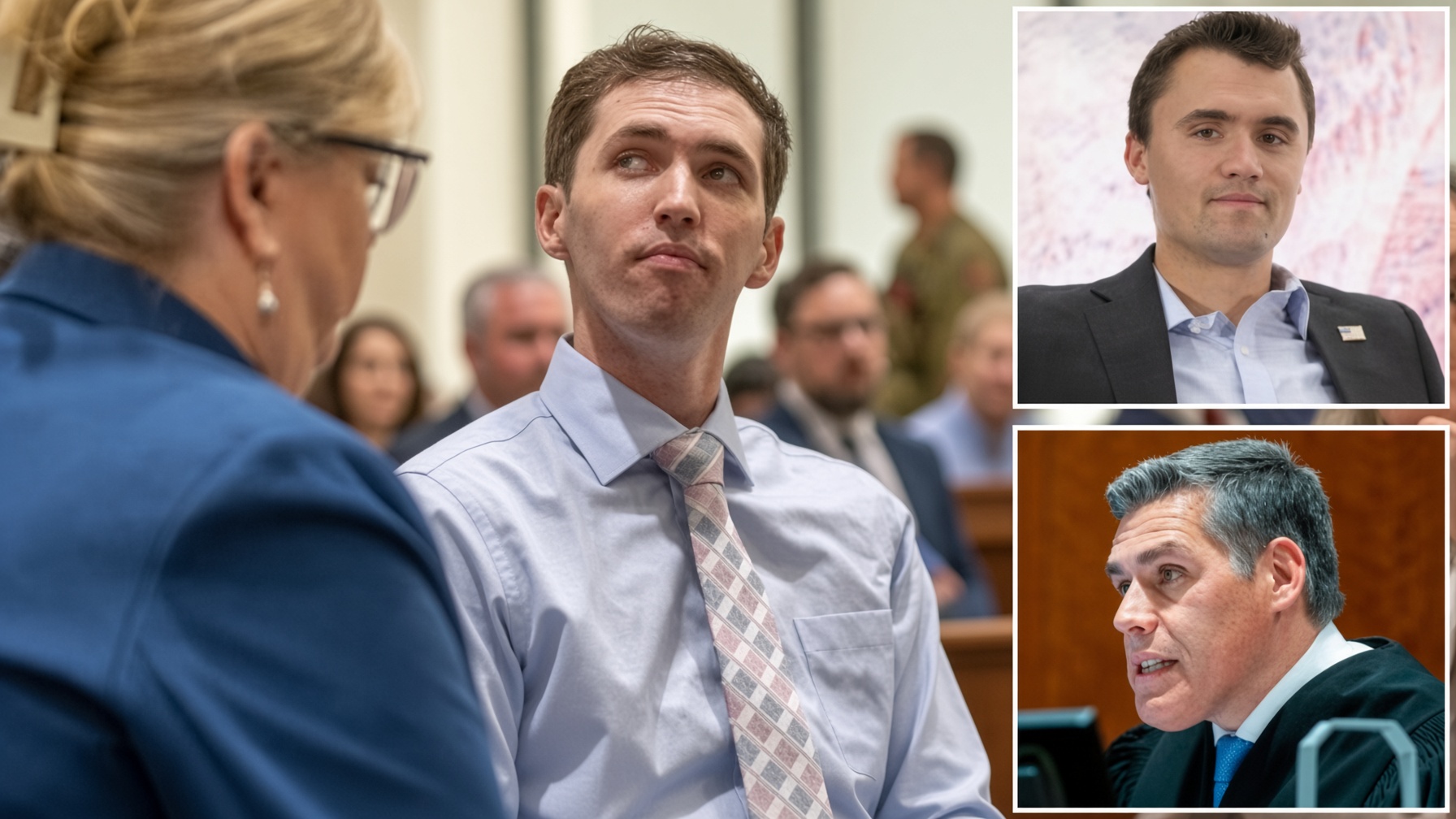
PROVO, Utah — A Utah state judge ruled Friday that Tyler Robinson will remain eligible for capital punishment if convicted of aggravated murder in the fatal shooting of political commentator Charlie Kirk, rejecting a defense bid to strike the death penalty following prosecutorial commentary that breached a court gag order.
Fourth District Judge Tony Graf Jr. found Deputy Utah County Attorney Christopher Ballard in civil contempt for publicly voicing confidence in the overarching strength of the state’s case against Robinson. However, the court held that disqualifying the prosecution from seeking the ultimate penalty was an improper remedy under Utah law, opting instead to address potential jury pool taint through an expanded voir dire process.
“The court finds that striking the death penalty is grossly disproportionate to the misconduct and legally unavailable in this civil contempt framework,” Graf said from the bench.
The ruling marks a pivotal milestone in a case that has drawn intense national interest, heightened legal posturing, and fierce debates over the boundaries of pretrial publicity.
Ballistics Dispute Triggers War of Words
The dispute over prosecutorial conduct erupted following dueling narratives regarding forensic ballistics testing conducted by the Bureau of Alcohol, Tobacco, Firearms and Explosives (ATF).
Defense attorneys submitted a filing indicating that federal ballistics analysts could not conclusively tie the bullet fragment recovered from Kirk’s body to the suspected murder weapon—a hunting rifle belonging to Robinson’s grandfather. The filing ignited immediate viral reporting and public commentary suggesting a major evidentiary hurdle for the prosecution.
Ballard and state prosecutors pushed back aggressively in the press, maintaining that their public comments were strictly intended to correct what they viewed as a misleading characterization of the forensic record. According to prosecutors, while the ATF described the microscopic toolmark analysis on the damaged bullet fragment as inconclusive, testing confirmed that the projectile was the identical caliber as the rifle. Furthermore, forensic technicians successfully matched a spent shell casing recovered at the crime scene to the weapon.
While Judge Graf affirmed that prosecutors retained a limited right to clarify factual distortions regarding specific court filings, he determined that Ballard crossed an ethical line in at least one subsequent media interview by expressing an opinion regarding the totality of the state’s evidence and Robinson’s culpability.
Graf held that those broader remarks violated the spirit and letter of the court’s protective orders, warranting a formal finding of civil contempt against Ballard, but stopping well short of the structural sanction sought by the defense.
Key Witness Granted Limited Immunity
As pretrial proceedings intensify, the evidentiary foundation of the state’s case has increasingly centered on testimony and digital records obtained from Robinson’s inner circle.
Court records confirm that Lance Twiggs, 22, a former roommate and romantic partner of Robinson, was granted limited use immunity concerning statements provided to investigators during an extensive, recorded interview on April 20. Under the terms of the agreement, Twiggs’ recorded disclosures cannot be introduced directly against him in separate criminal proceedings, paving the way for him to serve as a cornerstone witness for the state.
According to filings submitted by the Utah County Attorney’s Office, Twiggs reiterated earlier disclosures made to police shortly after the September 2025 shooting. Twiggs reportedly told detectives that Robinson admitted to carrying out the assassination, detailing how he concealed the bolt-action rifle, destroyed or discarded clothing worn during the incident, and instructed Twiggs to stonewall law enforcement.
Prosecutors also signaled their intent to enter a substantial evidentiary paper trail into the record, including screenshots of encrypted messages and SMS communications between Twiggs and Robinson immediately before and after the shooting.
The state disclosed those details while resisting an effort by Robinson’s defense counsel to compel Twiggs to testify live during an upcoming multi-day preliminary hearing. Prosecutors argued that a live appearance is legally redundant at this juncture because the court can evaluate the recorded interview alongside contemporaneous digital forensic data.
A String of Procedural Setbacks for the Defense
The denial of the death penalty motion represents the latest in a series of adverse procedural rulings for Robinson’s legal team.
Just days earlier, Judge Graf rejected a defense motion seeking to stay the proceedings pending an interlocutory appeal of his decision to permit broadcast cameras inside the courtroom. Robinson’s attorneys had argued that wall-to-wall television coverage would irreparably prejudice the jury pool in Utah County, but the court ruled that open-court access and standard pooled media arrangements would be maintained under strict judicial guidelines.
Robinson is accused of opening fire on Sept. 10, 2025, during an outdoor Turning Point USA event hosted on the campus of Utah Valley University in Orem. The shooting, which occurred before a crowd of hundreds of students and attendees, resulted in Kirk’s immediate death and triggered a regional manhunt that concluded with Robinson’s arrest.
Robinson, who has observed recent status conferences via video link from the Utah County Jail, has not yet entered a formal plea to the aggravated murder charge. Under Utah criminal procedure, a formal plea is entered only after the conclusion of a preliminary hearing, where the state must establish probable cause that the defendant committed the charged offenses.
The comprehensive preliminary hearing is scheduled to run over the course of a week in early July, where Judge Graf will evaluate ballistic analyses, crime scene reconstruction, and Twiggs’ recorded interview to determine whether the capital case proceeds to trial.