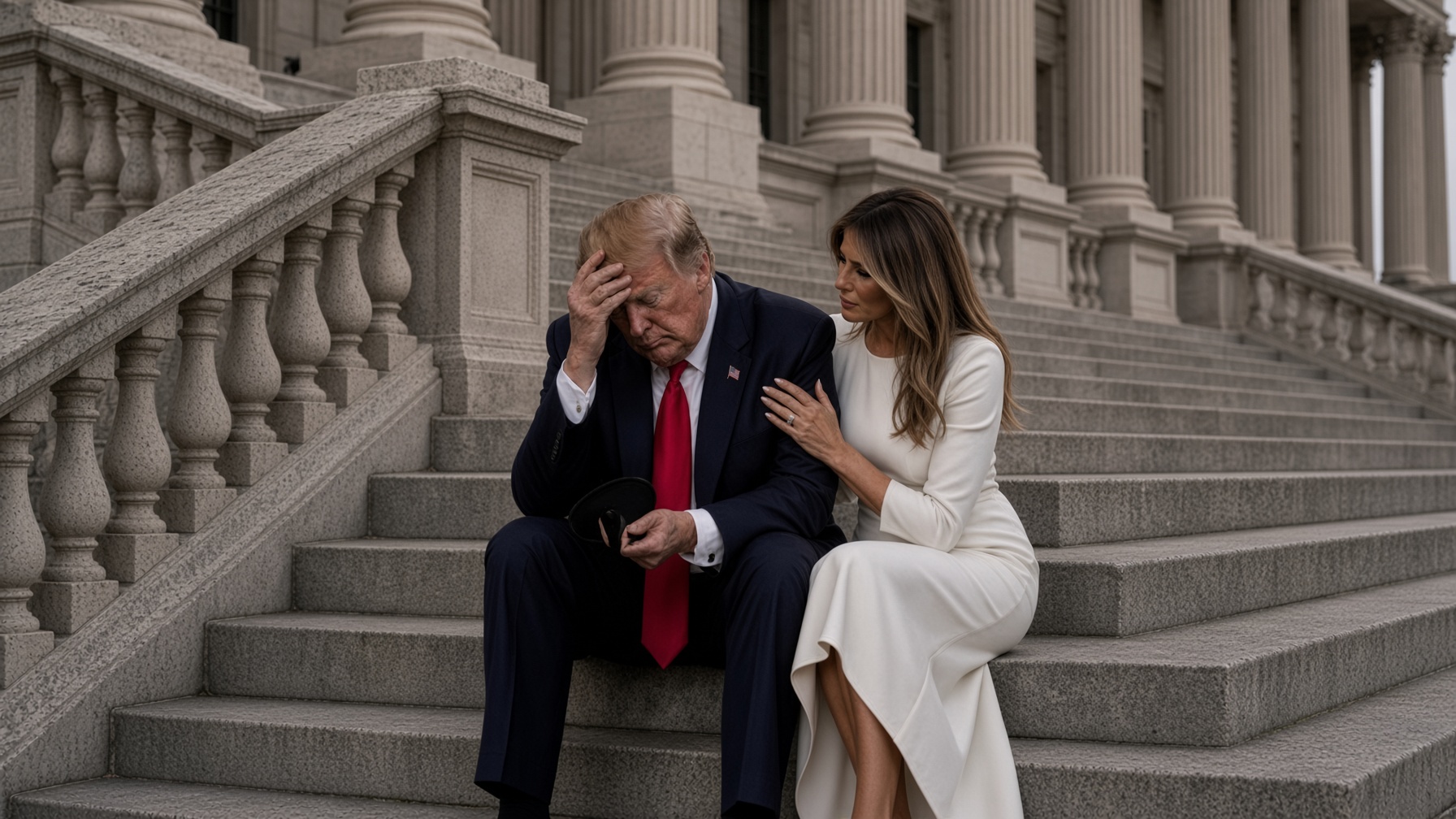
WASHINGTON — In a capital accustomed to political confrontation, motorcades, flashing cameras and relentless news coverage, moments of silence can sometimes carry more meaning than the loudest speech.
For Donald Trump, whose political career has been defined by public confrontation and an extraordinary ability to dominate the national conversation, a quieter moment can invite a different kind of reflection: not necessarily about defeat or retreat, but about the passage of time and the lasting consequences of political power.
The scene described in Washington offered a striking contrast to the spectacle that has accompanied much of Trump’s public life. There were no campaign chants, no packed rally stage and no extended political address. Instead, the emphasis was on stillness—a moment that can be interpreted in many ways but that, at minimum, underscored the distance between political events as they happen and the historical judgment that follows them.
A Career Defined by Momentum
For nearly a decade, Trump has maintained a political presence unlike that of almost any other modern American figure.
His rise transformed the Republican Party, reshaped presidential campaigning and generated an unusually intense relationship between the White House, the news media and Trump’s supporters.
His political career has also been marked by extraordinary institutional conflict. He became the first president to be impeached twice, faced multiple criminal indictments after leaving office and continued to command substantial political influence despite those challenges.
Through much of that period, Trump’s public strategy emphasized movement rather than reflection. Controversies were answered with counterattacks, criticism was frequently met with confrontation, and political setbacks were often presented as temporary obstacles rather than definitive conclusions.
That approach helped sustain his political relevance through periods when many observers expected his influence to diminish.
But political momentum does not eliminate the passage of time.
When Politics Becomes History
The meaning of a political career inevitably changes as individual events become part of the historical record.
Presidential decisions that once dominated daily headlines eventually become subjects for historians, courts, scholars and future generations. Campaign arguments become archival material. Executive orders become part of institutional history. Political battles that once appeared immediate can eventually be viewed as chapters in a much longer national story.
That process has particular significance for Trump because his presidency and political movement produced changes across numerous areas of American public life.
His administration reshaped the federal judiciary, altered the Republican Party’s political identity and intensified debates over executive authority, immigration, trade, foreign policy and the relationship between government institutions and the media.
Supporters regard many of those changes as evidence of a political movement that challenged established Washington practices. Critics argue that some of the same developments placed significant pressure on democratic norms and institutional safeguards.
Whatever the political interpretation, the impact has been substantial.
Beyond the Immediate Political Battle
Modern political coverage frequently focuses on immediate developments—poll numbers, campaign strategy, fundraising, statements from political opponents and the next news cycle.
Those measures are important for understanding day-to-day politics, but they do not necessarily determine how a presidency will ultimately be remembered.
Historical evaluation operates on a much longer timetable.
A leader’s legacy can depend on what institutions remain after the political battles have ended, how courts interpret major decisions, how successors respond to established precedents and how citizens evaluate the broader consequences of a period in power.
For Trump, the competing interpretations of his political legacy are already deeply established.
His supporters view him as a transformative political figure who challenged entrenched institutions and changed the direction of the Republican Party. His opponents see his presidency and political movement as a period that tested institutional boundaries and intensified divisions across the country.
Those competing perspectives are unlikely to disappear quickly.
The Limits of Political Power
The presidency is among the most powerful offices in the world, but it is also temporary.
Every administration eventually gives way to another. Political alliances change. Public attention moves elsewhere. Officials leave office, and institutions continue operating under new leadership.
That tension between temporary authority and lasting consequences is one of the defining features of American government.
A president can influence the direction of the country, but no president completely controls how that influence will ultimately be interpreted.
For Trump, whose political identity has been closely associated with personal dominance and constant visibility, the transition from political events to historical judgment may prove especially significant.
The loudest moments of a presidency often dominate contemporary coverage. Yet the quieter periods that follow can reveal how deeply those moments altered institutions and public life.
History Moves Slowly
As Washington returns to its familiar rhythm of meetings, hearings, briefings and political negotiations, the machinery of government continues regardless of any individual personality.
There is rarely a single moment when history announces its final judgment.
Instead, reputations evolve gradually. Court decisions are issued. Policies are reassessed. Institutions adapt. Citizens reconsider earlier events through the perspective of time.
For Trump, the ultimate assessment of his political career will therefore extend far beyond any single speech, controversy, election or legal proceeding.
His legacy will be debated for years, perhaps decades, across political parties and generations.
In the end, history is not written solely by the people who dominate a particular news cycle. It is shaped by the institutions that endure, the decisions that remain consequential and the citizens who determine what those decisions ultimately mean.
In Washington, where political noise is almost constant, moments of quiet can serve as a reminder of that larger reality: power may command attention in the present, but its consequences are measured over time.



