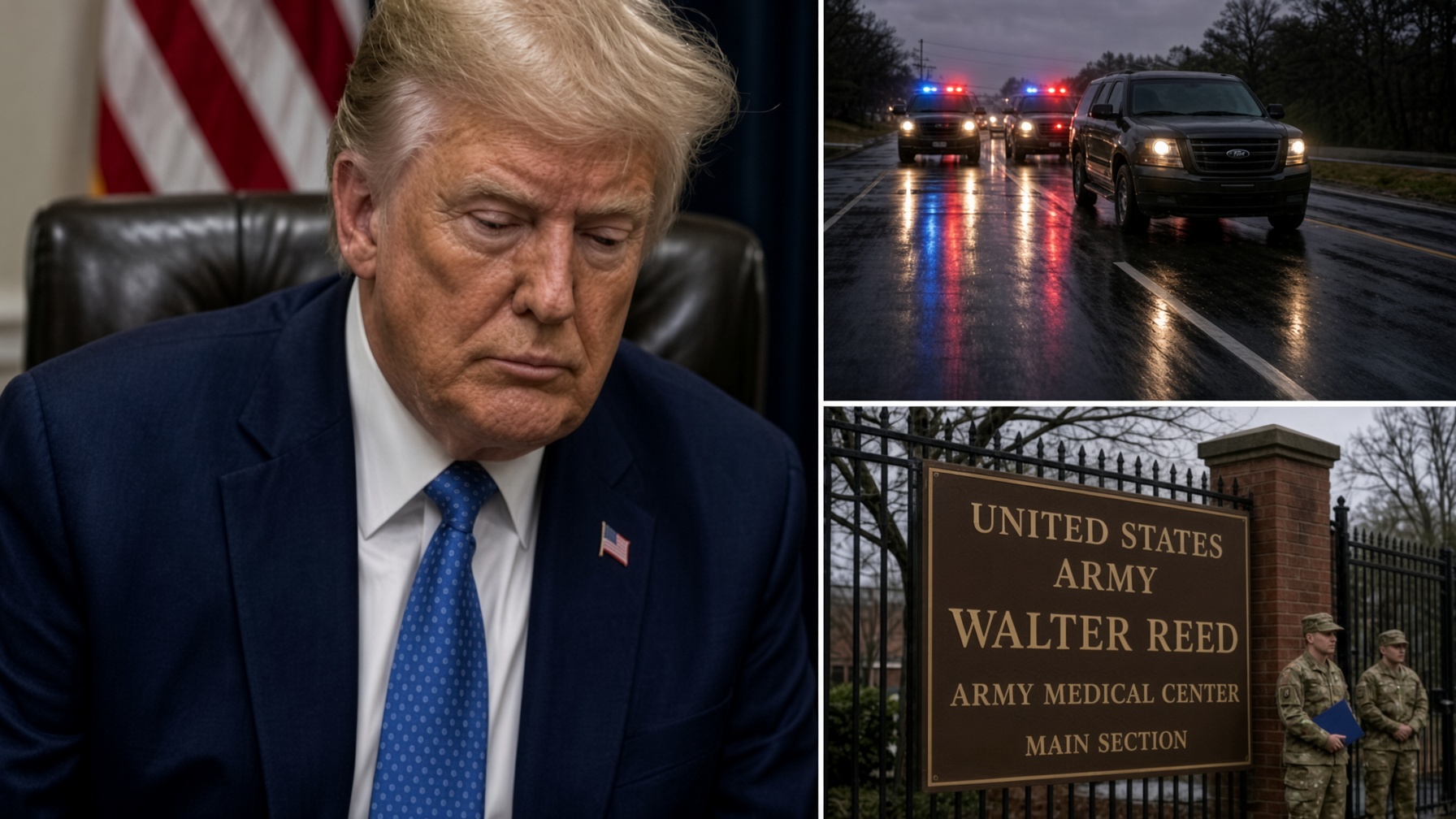
🩺 White House Physician Declares Trump ‘Fully Fit’ Following Annual Walter Reed Examination
WASHINGTON — President Donald Trump remains in “excellent health” and retains the physical and cognitive stamina necessary to discharge the duties of head of state and commander in chief, according to an official medical assessment released Friday by the White House following a multi-hour examination at Walter Reed National Military Medical Center.
The comprehensive evaluation, overseen by presidential physician Dr. Sean Barbabella alongside a multidisciplinary panel of 22 medical specialists, examined cardiac health, pulmonary function, neurological indicators, and metabolic markers. The resulting memorandum concluded that the president demonstrates robust baseline health, marked by sharp improvements in lipid profiles and a flawless evaluation on standard cognitive metrics.
The disclosure marks the fourth publicly summarized physical examination of Trump’s second administration, arriving weeks before his 80th birthday and amid intensified national scrutiny over the vitality of aging chief executives.
Cardiovascular Metrics and Weight Profile
Trump, who measures 6 feet, 3 inches tall, recorded a body weight of 238 pounds during Friday’s clinic visit. The figure reflects an increase of 14 pounds compared to his April 2025 physical examination, yielding a body mass index (BMI) of 29.7. Under standard clinical classification thresholds established by the Centers for Disease Control and Prevention and the World Health Organization, a BMI ranging between 25.0 and 29.9 denotes the overweight category, placing the president just beneath the clinical cutoff of 30.0 for obesity.
Despite the weight fluctuation, the White House medical unit emphasized that cardiovascular testing revealed favorable functional parameters. Advanced cardiac imaging, preventative coronary screenings, and a non-invasive computed tomography (CT) scan revealed no emergent abnormalities or significant structural degradation.
The report credited a targeted pharmacological regimen for delivering substantial reductions in cardiovascular risk markers over several years. Trump’s total blood cholesterol dropped to 143 mg/dL, down sharply from the 223 mg/dL reported during his first presidential term in 2018:
-
Rosuvastatin: Prescribed to lower low-density lipoprotein (LDL) cholesterol while supporting protective high-density lipoproteins (HDL).
-
Ezetimibe: Administered adjunctive to statin therapy to inhibit intestinal cholesterol absorption.
-
Aspirin: Prescribed for vascular prophylaxis, with the medical staff noting a transition to low-dose formulation during this review.
Minor Symptoms and Managed Chronic Conditions
The memorandum addressed observable physical signs that had drawn public commentary in recent months, notably minor superficial bruising visible on Trump’s hands. Dr. Barbabella characterized the discoloration as benign soft-tissue irritation caused by repetitive handshaking during public appearances, aggravated by routine platelet inhibition from his aspirin regimen.
The evaluation also reviewed Trump’s previously disclosed diagnosis of chronic venous insufficiency, a common degenerative condition among older adults where vein wall valves fail to circulate lower-extremity blood back to the heart efficiently.
While the physician noted residual, mild swelling in the president’s lower legs, the report emphasized that the condition had demonstrably improved since evaluations in 2025. Medical staff recommended continuing regular ambulation, targeted lower-body movement, dietary moderation, and weight-management protocols to maintain healthy circulatory dynamics.
“His demanding daily schedule, including multiple high-level meetings, public engagements, and regular physical activity, continues to support his overall well-being,” Barbabella wrote, noting an absence of acute pulmonary, muscular, or neurological pathology across the panel’s reviews.
Cognitive Assessment and Political Backdrop
As in prior administrations, the clinical battery included the Montreal Cognitive Assessment (MoCA), a widely recognized 30-point screening instrument designed to detect mild cognitive impairment, executive function changes, and early signs of dementia. Trump achieved a score of 30 out of 30, matching his performance on identical assessments administered in 2018 and 2025.
The cognitive findings carry significant political weight. Presidential medical fitness has dominated Washington discourse since the 2024 campaign, when concerns regarding advanced age reshaped the political landscape following President Joe Biden’s eventual withdrawal from the contest. Trump, who holds the record as the oldest individual elected to the American presidency, routinely cites his clinical screenings on the campaign trail and in official appearances to contrast his operational readiness against his political opponents.
While the U.S. Constitution and federal law do not mandate the public release of a sitting president’s detailed medical records, administrations historically release structured summaries to allay voter concerns regarding leadership stability. With the White House preparing for a demanding legislative agenda and high-stakes midterm elections, aides pointed to Dr. Barbabella’s memorandum as definitive verification that the president remains fully capable of managing the domestic and global demands of the presidency.



