OREM, Utah — A year after the fatal shooting of Turning Point USA founder and CEO Charlie Kirk during an outdoor speaking engagement, the deep scars left by the tragedy continue to influence campus safety protocols, legal proceedings, and the national discourse on political violence.
Kirk, the 31-year-old prominent conservative activist, was fatally shot on September 10, 2025, while hosting an on-stage Q&A at Utah Valley University (UVU). The public event, the first stop on his widely publicized “American Comeback Tour,” was abruptly transformed from a political debate into a scene of terror and panic, leaving the broader conservative movement without one of its most influential youth organizers and the nation facing another dark chapter of political bloodshed.
With the accused gunman, 22-year-old Tyler Robinson, awaiting a capital trial, the fallout from the shooting remains an active point of grief and intense institutional review.
Minutes of Chaos on Campus
The assassination occurred around 12:20 p.m. MDT as Kirk answered a question on a heavily populated outdoor courtyard near the campus library. More than 3,000 students, staff, and attendees had gathered for the open-air event, which was secured by six police officers alongside Kirk’s private security detail.
As Kirk responded to an audience member’s question regarding mass shootings, a single high-velocity round struck him in the neck. An immediate wave of panic erupted through the massive crowd, with hundreds of attendees screaming, dropping to the ground, and scrambling toward campus exits as rumors of multiple active shooters spread. Cellphone footage captured the initial pandemonium as responders rushed the stage to administer aid. Kirk was transported to a local hospital in critical condition, where he died shortly afterward.
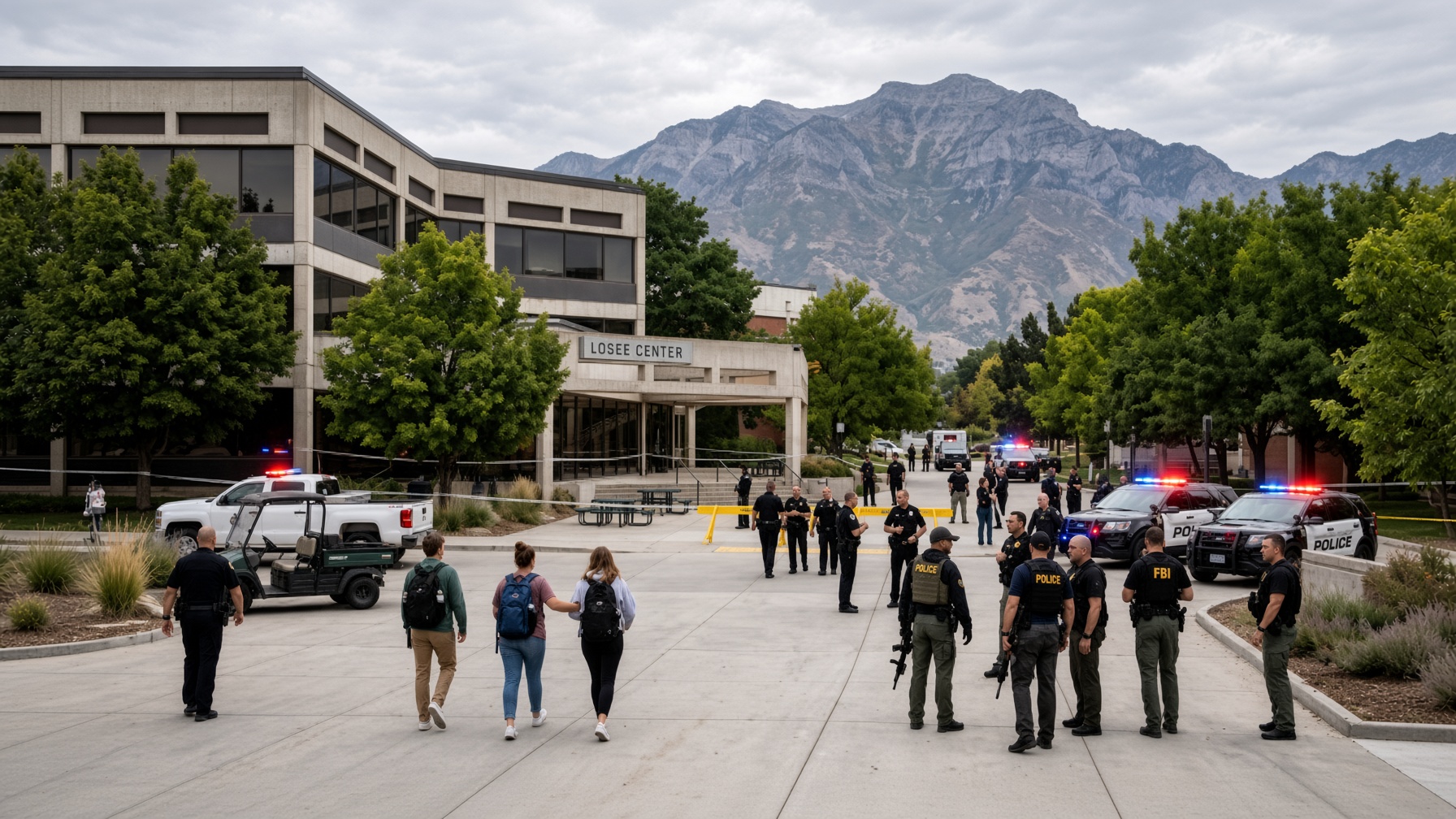
An immediate, multi-agency tactical response descended on the Orem campus. While officers secured the perimeter and searched for the shooter, the university was placed on a complete, hours-long lockdown, with students and faculty barricading themselves inside classrooms before being escorted off-site.
“Everyone was just running,” one student witness recalled. “It happened so fast, and when we heard the sound, the whole crowd just collapsed in panic. It felt like nowhere was safe.”
The Search and Arrest of Tyler Robinson
A massive search for the gunman quickly pointed to an elevated, 200-yard vantage point on the rooftop of the Losee Center, a multi-story campus building overlooking the courtyard.
Investigators recovering forensic evidence on the roof discovered footprints and a scoped rifle alongside casing materials. Reviewing surveillance and security footage, the FBI and local police identified a masked suspect wearing a black shirt and jeans fleeing the building stairwell and moving into a wooded area north of the campus.
Although a person of interest was briefly detained on the afternoon of the shooting, that individual was quickly cleared and released. The investigation progressed rapidly after the suspect’s parents recognized images released by the FBI and contacted law enforcement.
On the night of September 11—roughly 33 hours after the shooting—state and federal tactical units arrested Robinson, a resident of Washington, Utah, without incident.
Robinson was subsequently charged with aggravated murder and six other felony counts. The Utah County Attorney’s Office has announced it is seeking the death penalty, while Robinson’s defense team has petitioned the court for a delayed trial timeline, citing the complex evidentiary load.
Security Failures and Institutional Fallout
The tragedy has prompted rigorous, painful examinations of physical security at high-profile university events.
An independent, external security review released in 2026 revealed significant operational vulnerabilities. Critics pointed out that the open-air venue, surrounded by multiple elevated campus buildings with unmonitored roof access, was highly exposed. The event had been open to the public without metal detectors, comprehensive bag checks, or ticketing enforcement. The review also cited a critical lack of communication and coordination between UVU police and local municipal commands.
The fallout led to the resignation of UVU Police Chief Clint Long in October 2026, following mounting criticism of the security preparations. In response, the university appointed its first chief safety officer and instituted sweeping revisions to its visitor and event security protocols, including stricter roof-access controls and enhanced inter-agency coordination.
“Our goal is to ensure this never happens again,” UVU’s president said, noting that several safety recommendations from the external report are already underway. “This review will guide our continued effort to heal and protect our community.”
A Political Sledgehammer and Legacy of TPUSA
The assassination of Kirk, a fierce and uncompromising supporter of President Donald Trump who built TPUSA into a powerhouse of conservative youth activism, sent shockwaves through the American political establishment.
Utah Governor Spencer Cox swiftly condemned the killing as an act of political terrorism, a sentiment echoed by leaders from both parties who warned of the corrosive threat that violence poses to democratic discourse. Trump mourned Kirk publicly, calling him “great and legendary” and recognizing his pivotal role in mobilizing a generation of conservative students.
Kirk’s political career was defined by his tireless, decade-long effort to engage the cultural and political right on American college campuses. While his provocative, populist views often sparked intense opposition and campus protest, his influence among young conservatives remains undisputed. On September 21, 2025, an estimated 100,000 supporters and political figures gathered at State Farm Stadium in Glendale, Arizona, for a massive national memorial service, emphasizing the lasting scale of the movement he championed.
He is survived by his wife, Erika Frantzve, and their two young children.
As the legal proceedings against Tyler Robinson move toward a trial, the Orem shooting remains a stark, devastating reminder of the acute risks faced by public figures in an increasingly polarized nation—and the immense, fragile challenge of safeguarding free speech and political assembly on America’s college campuses.