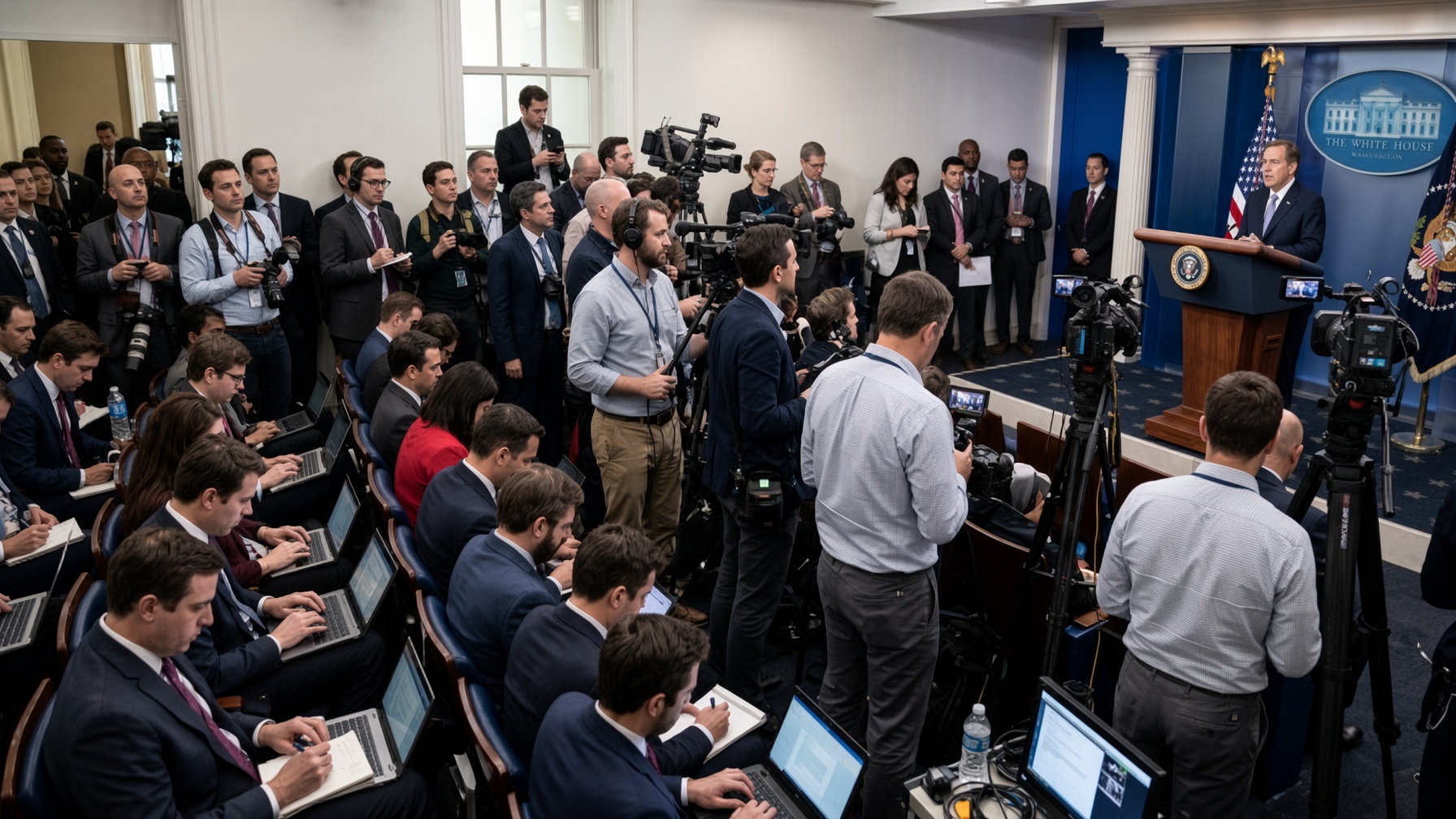
WASHINGTON — A sharp, escalating confrontation between President Donald Trump and the White House press corps has ignited a critical debate over executive access, journalistic independence, and the constitutional architecture of public accountability.
The dispute deepens as the administration aggressively implements a communications strategy intended to bypass traditional news outlets. At the center of the push is a proprietary executive mobile application, launched earlier this year, which streams unfiltered press briefings, policy directives, and personnel announcements directly to citizens. The White House champions the app as an egalitarian expansion of public transparency, while press freedom advocates argue the strategy systematically curtails the Fourth Estate’s capacity to subject executive power to adversarial scrutiny.
The clash extends beyond rhetorical sparring at the podium, reaching the core of American constitutional law and the informal operational customs that have defined executive-press relations for nearly a century.
Constitutional Rights and Discretionary Access
Ratified in 1791, the First Amendment commands that the government shall make no law abridging the freedom of speech or of the press. Yet, constitutional scholars highlight a structural tension within that protection: while the state cannot suppress unfavorable coverage or impose prior restraint, federal law does not guarantee journalists unfettered, physical entry into the West Wing. The executive branch retains broad administrative authority over press credentials, travel arrangements aboard Air Force One, and admission to the Oval Office.
Historically, this divide was mitigated through mutual reliance. Commanders in chief required major news organizations to broadcast their policy platforms, while correspondents relied on proximate access to observe decision-makers in real time. Today, that operational compact has collapsed. By pairing aggressive public critiques with in-house digital platforms, the White House has largely detached itself from the institutional leverage once commanded by traditional broadsheets and broadcast networks.
Sidestepping Traditional Gatekeepers
Trump’s adversarial posture toward established media has remained a fixture of his political identity for over a decade. In his second term, that posture has codified into deliberate administrative practice.
White House aides argue that legacy institutions long operated on an outdated entitlement model. Rather than focusing access exclusively on established news networks, the administration has elevated conservative commentators, regional publishers, podcasters, and independent digital content creators. The official mobile app formalizes this transition, effectively turning the executive branch into a direct-to-consumer publisher.
“The old gatekeeper model is dead,” a White House communications advisor remarked. “We believe every American has the right to see and hear from their president directly, without it being filtered, spun, or repackaged by a handful of Manhattan and D.C. newsrooms. This app democratizes the presidency.”
Media ethicists counter that public relations cannot replace a free and independent press. Unfiltered broadcasts disclose only the facts a government chooses to share, whereas investigative reporting is designed to verify assertions, surface procedural shortcomings, and uncover abuses of public trust. Without adversarial questioning, they warn, the public receives only a curated, one-sided narrative that undermines democratic oversight.
The shift is particularly visible in the James S. Brady Press Briefing Room, where the traditional, meticulously negotiated seating charts have been disrupted to accommodate a broader, more ideologically diverse array of commentators, often relegating legacy beat reporters to the sidelines or off-camera seats.
The Access Dilemma and Changing Digital Landscape
The ongoing realignment forces news organizations into a difficult posture: balancing access against uncompromised editorial independence.
When an administration signals that hard passes, seating charts, or entry to briefings may be altered in response to critical coverage, newsrooms face institutional friction. Outlets prioritizing access risk moderating their editorial posture, while correspondents who are locked out lose the capacity to pose pressing, face-to-face questions on behalf of the public.
This challenge is exacerbated by broader industry shifts:
Algorithmic Distribution: Audiences increasingly consume political developments via algorithmic feeds and raw executive clips rather than through edited, fact-checked news broadcasts.
Economic Attrition: Diminishing subscription and advertising revenues have strained newsroom budgets, complicating expensive legal actions for records disclosure and access defense.
Information Polarization: Deeply segmented audiences frequently perceive factual verification as evidence of partisan alignment, eroding shared baselines of public fact and leaving little public appetite to defend the institutional access of the press.
“Really, the harm falls on the public,” a media historian noted. “If newsrooms are forced to self-censor just to keep their seats, or if the most critical voices are simply banished, the people lose their eyes and ears inside the rooms where decisions are made.”
Court Dockets Replace the Briefing Room
The confrontation has expanded into the federal courts, where journalists and press groups are formally challenging administrative barriers to official information.
A primary front emerged when the Associated Press filed a federal lawsuit contesting executive directives that restricted digital access to immigration-related court dockets. The wire service argued that unprecedented administrative delays and system paywalls violated the First Amendment by hindering timely reporting on federal enforcement operations. In its complaint, the AP challenged Rule 5.2(c) of the Federal Rules of Civil Procedure, which blocks online public access to individual immigration habeas dockets on the court-record system PACER.
The AP contends the rule unconstitutionally “blocks PACER’s instantaneous access,” preventing journalists from reporting promptly on the treatment and legal challenges of detainees facing expedited removal under the administration’s heightened enforcement campaign. The news agency argued that this procedural boundary effectively prevents important cases from being brought to the public’s attention in a timely fashion, demonstrating how non-physical access restrictions can be just as damaging as a revoked press pass.
As the administration continues to hone its proprietary digital channels and the White House press corps defends its traditional oversight role, the outcome will fundamentally dictate whether the public retains an independent conduit into executive governance. If the legal and digital shifts continue on their current trajectory, the traditional relationship between the presidency and the press may be permanently replaced by a direct, unmediated broadcast—redefining what it means to be a watchdog in the digital age.