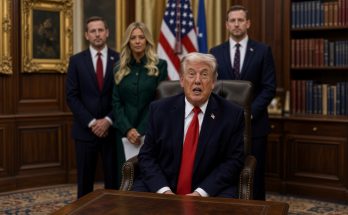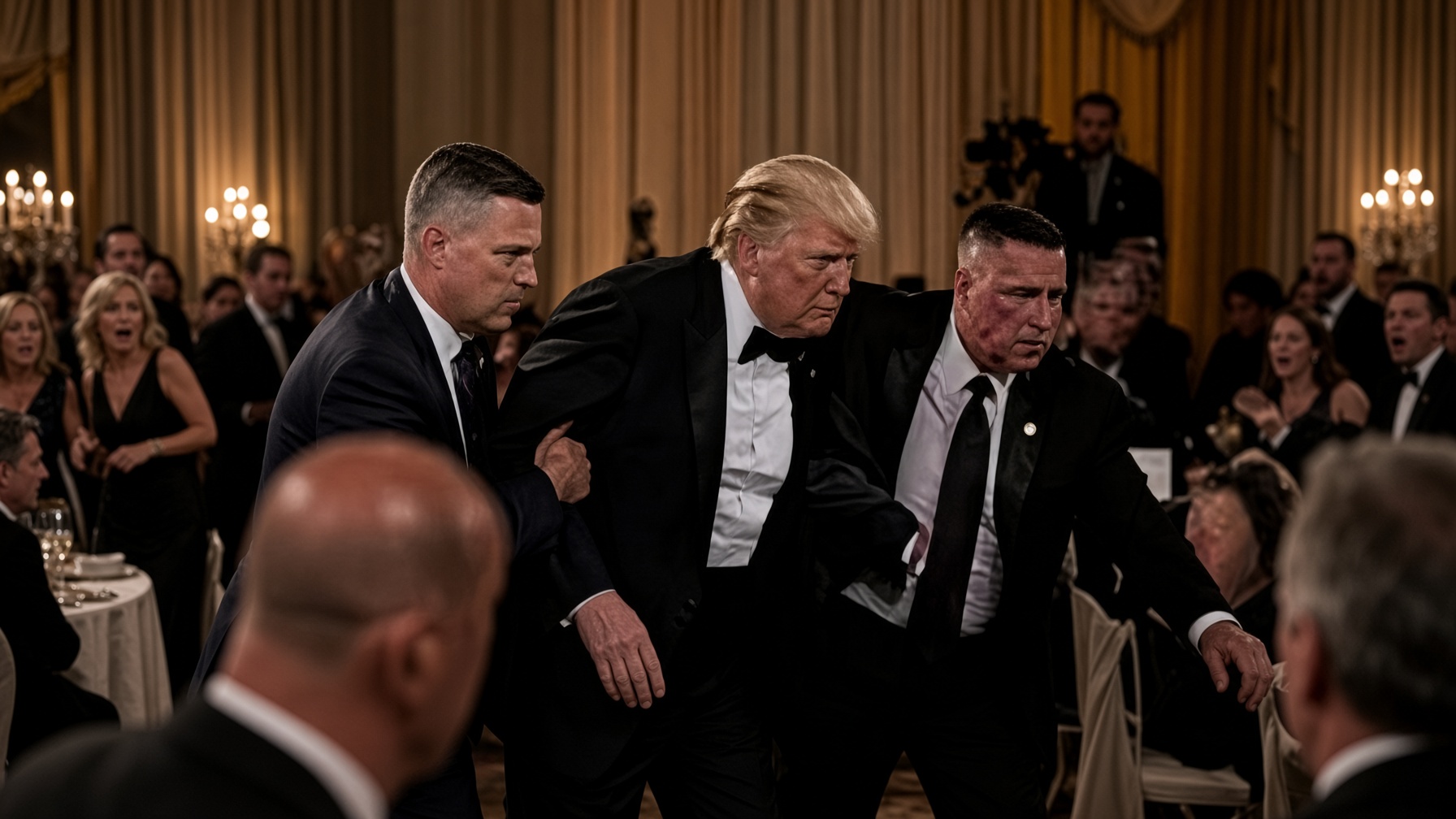
WASHINGTON — A cascade of viral social-media assertions alleging that President Donald Trump was “shot again” in Washington triggered widespread alarm and rapid online confusion, despite an absolute lack of corroborating evidence from federal law enforcement, medical centers, or accredited news organizations.
The unsubstantiated reports proliferated across digital platforms within minutes, pairing sensationalist breaking-news headers with claims that the commander-in-chief had survived another violent attack. However, official agency logs, traveling press dispatches, and District emergency services confirm that no kinetic assault, protective evacuation, or medical emergency involving Trump occurred.
The online frenzy appears to have stemmed from bad-faith distortions of a separate, contained security disturbance near the White House perimeter on Saturday, Sept. 19.
Vehicle Breach Near the Executive Perimeter
According to law enforcement briefings, uniform officers responded when an unauthorized vehicle mounted a sidewalk near the intersection of 16th Street and H Street Northwest, adjacent to Lafayette Square. The driver reportedly confronted security personnel and demanded to speak directly with Trump.
The president was not in residence at the White House during the confrontation, having departed earlier for the presidential retreat at Camp David, Maryland.
Secret Service officers, backed by Metropolitan Police units, immediately established a sterile cordon around the intersection, detained the driver without shots fired, and conducted comprehensive forensic and explosive sweeps of the vehicle. Following the all-clear, emergency personnel transported the individual to a regional medical facility for a psychiatric evaluation. Canine and hazardous-device sweeps yielded no weapons, explosives, or suspicious contraband inside the automobile.
Despite the localized, peaceful resolution of the perimeter breach, online aggregators quickly conflated the traffic stop with active gunfire.
Within hours, video clips of police cruisers with flashing emergency strobes were severed from their original context, paired with alarmist text, and presented as real-time documentation of an assassination attempt on the president.
Recycled History Amplifies Synthetic Panics
Disinformation analysts point out that rumors of political violence carry uniquely potent velocity when they trade on genuine historical trauma.
Foremost in the public consciousness is the confirmed assassination attempt against Trump on July 13, 2024, during an outdoor campaign rally in Butler, Pennsylvania. In that incident, an armed gunman opened fire from an unsecured rooftop, clipping Trump’s right ear, killing rally attendee Corey Comperatore, and critically wounding two other spectators before a Secret Service counter-sniper neutralized the shooter.
That watershed event permanently reshaped modern executive protection protocols, leading to sweeping congressional inquiries and heightened security postures nationwide. The attack remains an active subject of federal review; in September, Attorney General Todd Blanche noted that the FBI continues to review supplementary intelligence materials related to the broader Butler investigation.
However, security specialists emphasize that the confirmed reality of past political violence cannot be deployed to substantiate unverified digital rumors. By taking genuine collective memory and retrofitting it onto routine perimeter incidents, online actors manufacture viral engagement that bypasses normal reader skepticism.
Structural Hallmarks of Executive Crises
National security experts reiterated that a genuine armed attack on a sitting president triggers unmistakable, institutional protocols that cannot unfold in secret.
An active kinetic threat against the executive detail immediately sets off high-visibility continuity-of-government safeguards:
Immediate tactical cordons across the downtown District by the Secret Service Counter Assault Team (CAT) and federal tactical units.
The declaration of emergency Temporary Flight Restrictions (TFR) across National Capital Region airspace by the Federal Aviation Administration and NORAD.
Immediate, on-the-record alerts transmitted to the White House traveling press pool, whose members maintain uninterrupted visual proximity to the president.
Emergency notifications across regional Level 1 trauma facilities, including Walter Reed National Military Medical Center.
None of those operational triggers occurred. Throughout the weekend, the White House maintained standard operational posture, and the president’s official schedule proceeded without interruption.
The episode stands as an acute case study in the perils of modern digital information ecosystems, where high-speed algorithmic amplification often elevates synthetic crises over verified reporting. Federal public safety agencies continue to urge news consumers to rely on primary on-the-record briefings from accredited law enforcement entities and institutional newsrooms before amplifying sensational breaking-news assertions.
All available evidence confirms that Donald Trump was not the target of a shooting in Washington, and claims alleging a new assault remain entirely baseless online fabrication.