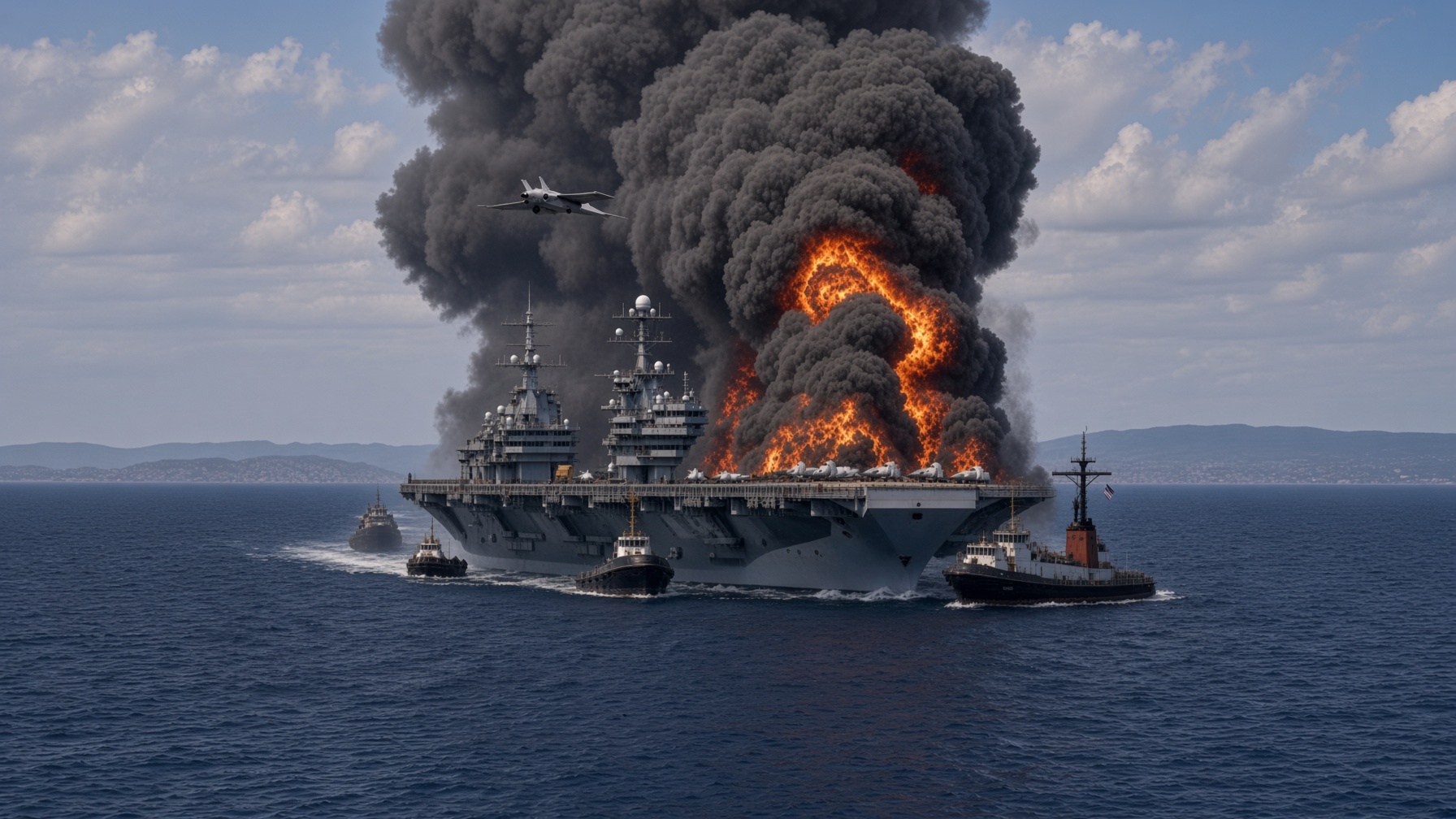
🚨 Reports Claim Russian Su-57 Stealth Fighter Struck High-Value Naval Target, but Key Details Remain Unverified
MOSCOW — Reports circulating online have sparked renewed debate over Russia’s advanced military capabilities after claims emerged that a Russian Su-57 stealth fighter may have carried out a strike against a heavily defended naval vessel. However, critical details surrounding the alleged operation remain unconfirmed, including the target’s identity, the location of the incident, the weapon reportedly used and the extent of any damage.
As of now, no independently verified evidence has established that the reported strike occurred as described. The claims have nevertheless drawn attention to the evolving contest between advanced combat aircraft and modern naval defense systems, particularly as military technology continues to reshape warfare.
🔎 Key Details of the Alleged Attack Remain Unclear
The online reports describe an attack against a high-value naval target, with suggestions that the vessel’s defensive capabilities may have been unable to prevent the strike. Yet the available information does not establish the ship’s name, nationality, operational status or location at the time of the alleged engagement.
There is also no independently confirmed account identifying the weapon involved, explaining how the attack was supposedly carried out or establishing whether the incident resulted in casualties or significant structural damage.
These gaps make it difficult to assess the credibility and potential significance of the claims. Military analysts typically seek corroboration through official statements, verified photographs and videos, satellite imagery, geolocation analysis and reporting from sources with direct knowledge of an operation.
Without such evidence, assertions that a warship was destroyed or that its defensive systems were decisively defeated would be premature.
✈️ Russia’s Su-57 Stealth Fighter Explained
Developed by Russia’s Sukhoi design bureau, the Su-57 is a fifth-generation multirole combat aircraft designed to combine reduced radar observability, advanced sensors and sophisticated onboard systems. It is intended to operate in contested airspace and conduct missions involving air-to-air combat and attacks against ground targets.
The aircraft has become an important part of Russia’s efforts to develop advanced combat aviation capabilities. Its design incorporates features intended to reduce its radar signature, although stealth technology does not make an aircraft invisible or guarantee that it can evade every detection system.
The aircraft’s actual performance in any particular engagement depends on several factors, including mission planning, available intelligence, weapon selection, electronic warfare and the capabilities of opposing forces.
Even if a Su-57 involvement in the alleged strike were eventually confirmed, that alone would not establish that the aircraft could consistently overcome every modern naval defense system. A meaningful assessment would require evidence about the specific circumstances and operational results.
🛡️ Why Modern Warships Can Still Face Threats
Modern warships often rely on layered defensive networks designed to detect, track and intercept incoming threats. Depending on the vessel, these may include advanced radar, electronic warfare equipment, surface-to-air missiles and close-in weapon systems intended to engage threats approaching at short range.
Such systems can provide substantial protection, but no defensive arrangement guarantees interception under every possible circumstance.
The outcome of an engagement can depend on warning time, the number and direction of incoming weapons, radar coverage, crew readiness, electronic interference and the technical characteristics of the attacking systems.
Consequently, a confirmed successful strike would require a detailed examination of how the engagement unfolded. It would not automatically prove that naval defenses had become ineffective or that one aircraft had fundamentally changed the balance of military power.
🌐 Online Claims Fuel Speculation
The incident also highlights the challenges of verifying military information during periods of international tension. Images and videos shared on social media may be authentic but misidentified, taken from earlier events or presented without sufficient context.
Repeated claims can also appear to have multiple independent sources when they originate from a single unverified report.
The absence of confirmation does not necessarily prove that an incident never occurred. It does, however, mean that the available information is insufficient to establish what happened or determine the consequences.
⚠️ Wider Military Implications Remain Uncertain
If a major strike against a heavily defended naval vessel were independently confirmed, it could raise important questions about force protection, operational readiness and the continuing competition between offensive weapons and defensive technology.
The broader implications would depend on the vessel involved, the location of the engagement, the military forces concerned and the circumstances surrounding the alleged attack.
For now, however, the reports do not establish that a new military crisis has emerged or that the strategic balance between Russia and its potential adversaries has shifted.
The bottom line: Claims involving Russia’s Su-57 stealth fighter and a high-value naval target remain unverified. Until credible evidence emerges, conclusions about the alleged attack, the effectiveness of the aircraft or the failure of naval defenses should be treated cautiously. Establishing the facts will be essential before analysts can determine whether the reports describe a significant military development or an unsubstantiated claim circulating online.