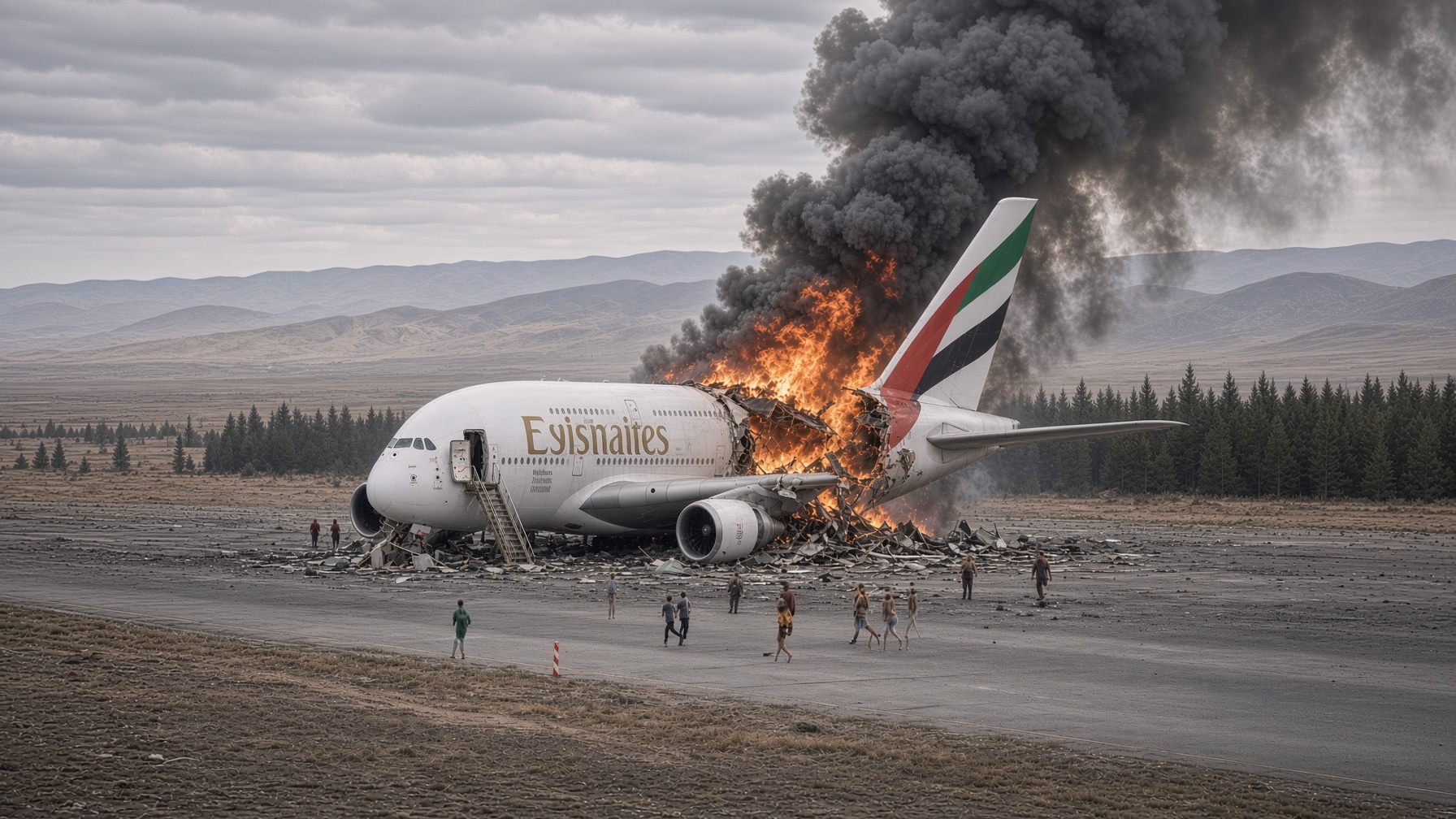
DUBAI, United Arab Emirates — What began as a routine international flight ended in a terrifying aviation emergency when Emirates Flight EK521 crash-landed at Dubai International Airport on August 3, 2016, leaving a passenger aircraft engulfed in flames and triggering a major emergency response. Although all 300 passengers and crew members survived the incident, a firefighter lost his life while responding to the blaze.
The dramatic crash landing became one of the most widely reported aviation incidents of the year, drawing international attention to aircraft evacuation procedures, emergency preparedness, and the dangers faced by first responders during airport emergencies.
The Boeing 777 was operating a scheduled service from Thiruvananthapuram, India, to Dubai. The flight had appeared routine until the aircraft approached its destination and encountered difficulties during landing. What followed unfolded within minutes, transforming an ordinary journey into a desperate struggle to escape a burning aircraft.
⚠️ A Routine Landing Turns Into an Emergency
As the aircraft approached Dubai International Airport, the flight crew prepared for landing. The plane touched down on the runway at approximately 12:45 p.m. local time, but the landing did not proceed as expected.
The aircraft experienced a serious landing incident before coming to a stop on the runway. Flames and thick smoke soon engulfed the plane, prompting airport authorities to activate emergency procedures and dispatch firefighting and rescue teams.
For passengers inside the cabin, the sudden emergency created an atmosphere of confusion and fear. People who had expected to arrive safely at their destination were suddenly confronted with the possibility of a life-threatening situation.
The aircraft carried 282 passengers and 18 crew members, bringing the total number of people on board to 300. With the plane on fire, the immediate priority was to evacuate everyone as quickly as possible.
🚨 Desperate Evacuation as Flames Engulf the Aircraft
Cabin crew members directed passengers toward emergency exits as evacuation slides were deployed. Smoke, alarms, and urgent instructions added to the intensity of the situation, while passengers rushed to leave the aircraft.
In such emergencies, aviation safety procedures require passengers to abandon their belongings and follow crew instructions. Carrying luggage can obstruct narrow aisles, slow evacuation, and put other passengers at risk.
The rapid evacuation of all 300 people became the defining outcome of the incident. Passengers escaped onto the runway while airport emergency personnel worked to contain the growing fire.
Images of the burning aircraft soon circulated internationally, showing the scale of the destruction and the urgency of the rescue operation. The fuselage was badly damaged, and the fire left the aircraft beyond repair.
Despite the frightening circumstances, no passenger or crew member died in the crash landing. The successful evacuation demonstrated the importance of cabin crew training, coordinated emergency procedures, and rapid action during a crisis.
🕯️ Firefighter Dies During Rescue Operation
While the survival of everyone aboard was a remarkable outcome, the incident also brought a tragic loss.
A firefighter involved in the emergency response died while carrying out rescue operations. His death underscored the extraordinary risks faced by airport firefighting teams, who must approach burning aircraft amid intense heat, smoke, and the possibility of further hazards.
Firefighters responding to aircraft incidents face particularly challenging conditions because aviation fuel can intensify a blaze, while damaged aircraft structures may complicate access and rescue efforts.
The firefighter’s death cast a shadow over the otherwise extraordinary survival story. His sacrifice became a central part of the incident’s legacy, highlighting the courage and commitment of emergency personnel who put themselves in danger to protect others.
Reports following the crash also indicated that some passengers received medical treatment for injuries. The most significant outcome, however, was that all 300 people aboard escaped alive.
🔎 Investigators Examine What Went Wrong
The circumstances surrounding the crash landing prompted aviation investigators to examine the aircraft’s final approach, landing conditions, and the sequence of events that followed touchdown.
Weather conditions, including the possibility of wind shear, were among the factors discussed in reports about the incident. Wind shear involves a sudden change in wind speed or direction and can affect an aircraft’s performance during critical phases of flight.
However, determining the precise causes of an aviation accident requires a detailed investigation. Flight data recorder information, cockpit voice recordings, aircraft systems, maintenance documentation, and meteorological evidence can help investigators reconstruct what happened.
Any claim that a landing gear malfunction or wind shear directly caused the incident must be assessed against the findings of the official investigation rather than assumed from preliminary accounts.
The crash also reinforced the importance of examining how aircraft behave during landing emergencies and how quickly passengers can exit when fire threatens the cabin.
🛫 Airport Disruptions and Renewed Attention to Aviation Safety
The emergency temporarily disrupted operations at Dubai International Airport, one of the world’s busiest international aviation hubs. Airport authorities had to coordinate firefighting efforts, secure the affected runway, and manage the resulting operational interruptions.
For Emirates, the incident became a major test of emergency response and passenger safety procedures. The successful evacuation demonstrated how crew training and established protocols can help protect lives even when an aircraft is severely damaged.
Modern commercial aviation relies on multiple layers of protection, including pilot training, aircraft maintenance, fire-response planning, emergency exits, and mandatory evacuation procedures. Yet the Dubai incident showed that even a rare emergency can develop rapidly, leaving little time for passengers to react.
❤️ A Survival Story Marked by Sacrifice
The crash of Emirates Flight EK521 remains a powerful example of how a potentially catastrophic aviation accident can end without a single passenger or crew fatality.
For the 300 people aboard, the experience was a frightening reminder of how quickly an ordinary flight can turn into an emergency. For the firefighter who died, the incident became a story of courage and service under the most dangerous conditions.
Ultimately, the event left two enduring lessons: emergency preparedness can save hundreds of lives, and the people who respond to disasters often face risks that others can scarcely imagine.
Although the aircraft was destroyed, the successful evacuation of every passenger and crew member stands as a testament to the importance of training, teamwork, and decisive action when seconds matter most.



