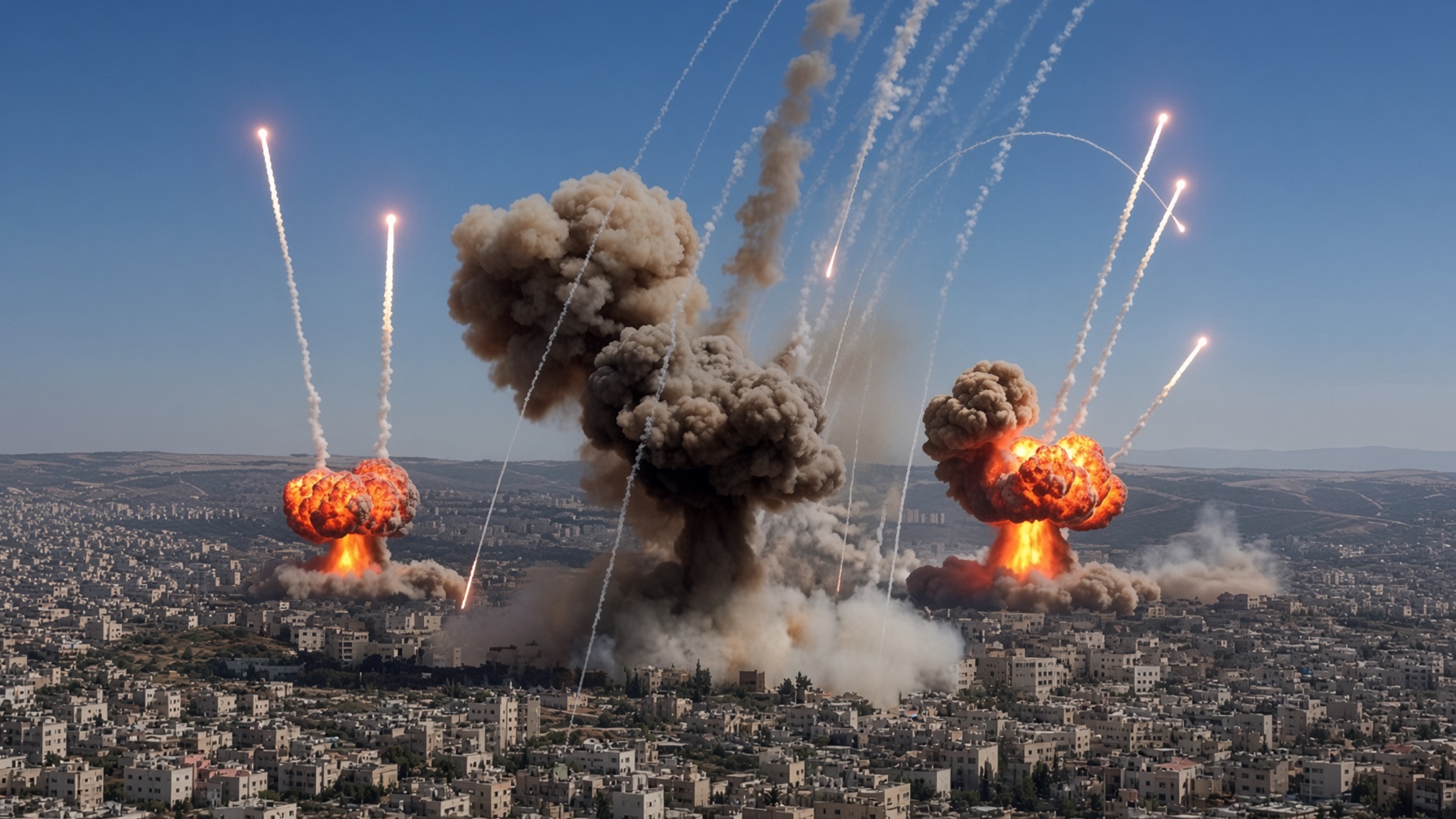
DUBAI — The Persian Gulf has shifted onto an active war footing as Iranian missile and drone salvos target military installations hosting American forces, testing regional air defenses and triggering emergency alarms across Gulf Arab capitals.
The confrontation is no longer a localized standoff. Tehran’s persistent retaliatory strikes against strategic positions across Bahrain, Qatar, Kuwait, and the United Arab Emirates demonstrate how swiftly direct military hostilities have enveloped the wider waterway. With thousands of American service members and allied assets permanently deployed across these host nations, the Gulf’s critical infrastructure sits directly in the crosshairs of every escalatory cycle.
Air Defenses Tested Across the Emirates
In the United Arab Emirates, defense forces have repeatedly scrambled surface-to-air interceptors following incoming aerial threats and widespread explosions near urban centers. While Emirati multi-tiered missile defense batteries have successfully downed incoming ballistic trajectories and unmanned aerial systems, regional installations tied to Western operations remain under persistent strain.
Al Dhafra Air Base, located south of Abu Dhabi, represents a central nerve center for coalition flight operations, advanced reconnaissance, and tactical air wings. Iranian forces have repeatedly singled out installations linked to U.S. forces in the UAE, underscoring that premier installations are vulnerable to saturation barrages. Defense analysts and military officials continue to stress that while Iranian state media frequently claims extensive damage, verified operational assessments remain tightly held by defense ministries pending comprehensive post-strike reviews.
Maritime Hubs and Forward Commands in the Crosshairs
The threat landscape extends across the Gulf’s northern and central littoral zones:
-
Bahrain: Home to Naval Support Activity Bahrain and the forward headquarters of the U.S. Navy’s Fifth Fleet, the island kingdom serves as the operational spine of Western maritime power in the Middle East. Bahraini authorities have scrambled interceptors as incoming fire targeted military infrastructure, including locations near the Sheikh Isa sector.
-
Qatar: Al Udeid Air Base, situated outside Doha, serves as the forward headquarters for U.S. Central Command (CENTCOM). The massive air hub has faced direct targeting and airspace violations, with commercial satellite passes revealing structural damage to auxiliary infrastructure following prior rounds of projectile impacts.
-
Kuwait: Frontline bases such as Camp Buehring and Ali Al Salem Air Base have absorbed repeated drone and missile strikes. Kuwaiti defense forces have engaged waves of low-flying aerial targets as air defense sirens routinely disrupt commercial hubs and strategic oil processing complexes.
This consistent targeting demonstrates that allied Gulf territories—often relying on shared radar, early warning networks, and Patriot batteries—are absorbing the operational fallout of a confrontation centered between Washington and Tehran.
The Chokepoint Dilemma at Hormuz
Beyond base perimeters, the geopolitical crisis poses an immediate threat to the Strait of Hormuz, the maritime artery through which roughly a fifth of the world’s petroleum and liquefied natural gas transits.
Repeated projectile strikes on commercial tankers, drone harassment, and naval interdictions have upended commercial shipping routines. Maritime risk insurance premiums have surged, commercial container traffic has diverted around southern Africa, and naval escort missions have struggled to fully insulate civilian traffic.
Energy market tracking by organizations such as Kpler and international reporting from Reuters reflect sharp volatility in Brent crude pricing whenever naval clashes or terminal disruptions occur. Even brief disruptions to transit channels carry the potential to trigger systemic global inflation and severe fuel supply bottlenecks.
A Narrowing Window for De-escalation
For regional militaries and deployed American personnel, daily routines have shifted entirely to perimeter security, layered air defense, and rapid threat interception. However, military analysts warn that missile defense systems face inherent mathematical limits against sustained saturation attacks.
The strategic reality across the Gulf is now defined by hair-trigger readiness. With military facilities, industrial energy terminals, and dense population centers coexisting within minutes of Iranian launch sites, a single unintercepted missile impact or high-casualty strike threatens to shatter existing containment efforts and pull the entire theater into an uncontrolled, open-ended regional war.



